









Who Created Lab Diamonds? A Full History
Updated 12 November 2026
The history of lab diamonds involves several teams, rather than one inventor. Sweden’s ASEA grew diamonds under high pressure in 1953 but kept the work private. At General Electric, H. Tracy Hall and his colleagues achieved reproducible diamond growth in December 1954, then announced their success in February 1955.
Those early stones were made for industrial use. Turning a scientific breakthrough into diamonds suitable for jewellery took much longer. Here are the milestones that connect those first experiments with the rings available today.

Who first grew diamonds in a laboratory?
Researchers had tried to make diamond from carbon for decades. The successful work of the 1950s followed two different routes: high pressure and high temperature, known as HPHT, and chemical vapour deposition, or CVD.
- 1952: GIA records early CVD work by William Eversole at Union Carbide, producing tiny diamonds.
- 1953: ASEA in Sweden successfully grew HPHT diamonds, without announcing the achievement at the time.
- December 1954: Hall’s work at GE established a reproducible HPHT process.
- February 1955: GE made its breakthrough public. The team’s paper, Man-Made Diamonds, followed in Nature in July 1955.
These dates describe different events: making a diamond, repeating the result and telling the world about it. That distinction explains why accounts sometimes name different years. GIA’s history of synthetic diamonds covers the early work, while the National Inventors Hall of Fame’s account of Hall distinguishes the 1954 experiment from the 1955 announcement.

How are lab-grown diamonds made?
HPHT uses intense pressure and heat to grow diamond from a carbon source. CVD takes a different route: carbon-containing gas in a chamber supplies carbon that builds on a diamond seed. It does not recreate the high-pressure conditions deep underground.
Both methods produce diamond, with essentially the same chemical composition and crystal structure as natural diamond. They can leave different growth features, which gemmological laboratories use to help identify origin. A diamond’s growth method alone does not tell you its colour, clarity or appearance.
A grading report describes the individual stone. Our guide to IGI vs GIA: Diamond Certification explains what to look for when comparing reports.

From industrial diamonds to jewellery
The first commercially useful lab diamonds were small crystals suited to cutting, grinding and polishing. GE announced gem-quality diamonds in 1971, but producing them was still too costly to make them a practical jewellery option at that stage.
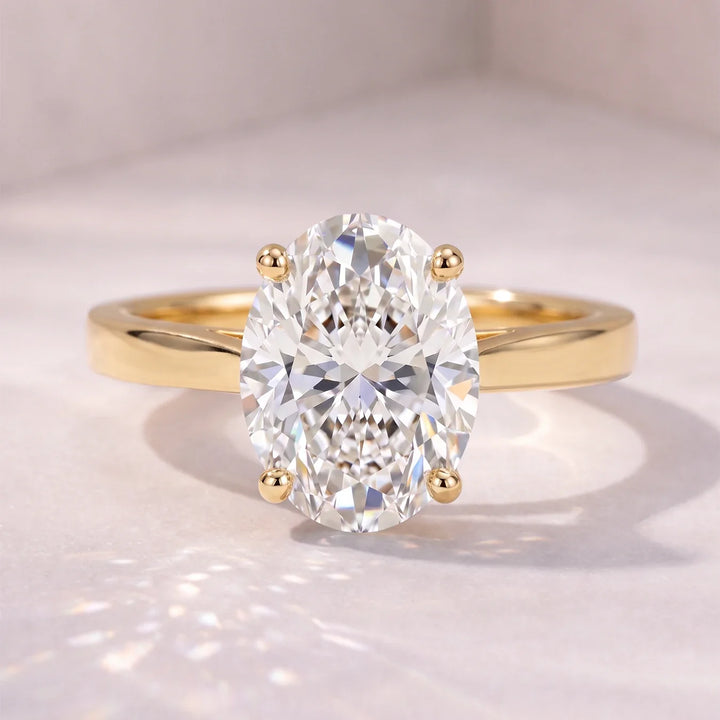
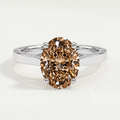
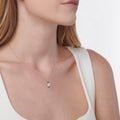
Over the following decades, improvements in growth and treatment made a wider range of jewellery-quality stones possible. The rings pictured here show modern designs; they are not photographs of the early experiments.
If you are choosing a ring now, compare current stones and complete-ring prices. A fixed percentage saving against natural diamonds quickly becomes unhelpful: weight, quality, setting and the particular stones being compared all matter. For a design built around your preferences, How to Design an Engagement Ring: A Complete Guide sets out the decisions involved.

Lab-grown and natural diamonds: what differs?
Lab-grown diamonds are diamonds. Their origin differs from that of mined diamonds, and laboratory testing can distinguish them. Neither origin guarantees a particular level of sparkle: the individual stone’s proportions, finish and other characteristics still matter.
Origin also does not, on its own, prove an ethical or environmental claim. If sourcing matters to you, ask what evidence supports the claim for the particular stone. For background on natural-diamond sourcing, read Natural Diamonds, Ethics, and the Kimberley Process.

A notable milestone: Celebration of India in 2024
In May 2024, IGI reported grading the 75.33-carat square emerald-cut Celebration of India, created by Ethereal Green Diamond. IGI described it as the largest lab-grown diamond at that time. That is a dated milestone, rather than a claim about today’s record.
The same announcement featured the 30.69-carat Infinity Ring, carved from a single laboratory-grown diamond crystal. Both appear in the original graphic below. Their scale illustrates the progress of the technology; it is far removed from the dimensions of a typical engagement-ring centre.

Seeing the designs for yourself
A photograph is a useful starting point, but a ring can look different as you move your hand. If you would like to compare designs in person, explore our Marylebone flagship store or Manchester showroom information before arranging a visit.
Our collection of lab diamond rings shows how different shapes work in solitaires, halos and three-stone settings. You can also explore lab diamond earrings and lab diamond bracelets if you are choosing jewellery for another occasion.