








Green Diamonds: Rarity, Meaning and Value
Updated 16 November 2026
A green diamond can look pale and fresh, richly coloured or tinged with yellow or blue. Before choosing one, it helps to separate two questions: how was the diamond formed, and how did it get its colour? Those answers matter to its description, rarity and price.
Naturally coloured green diamonds are rare. If it is the colour you are drawn to, our green lab grown diamond range offers another way to explore it. Look at the shade of the individual stone as well as the style of the ring.
What Makes a Diamond Green?
Compared with traditional colourless diamonds, green diamonds have a visible body colour. Natural radiation can alter a diamond’s crystal structure and produce green colour, but it is not the only cause. Other defects involving elements such as nitrogen, hydrogen or nickel can also contribute.
Some stones appear predominantly green; others have yellow, blue, grey or brown components. A pale green and a darker green can feel quite different on the hand, even when their size and shape are similar.
Diamond Origin and Colour Treatment
A diamond can be natural or lab-grown, and either can undergo colour treatment. “Lab-grown” describes how the diamond formed; it does not tell you whether its colour was changed afterwards. Similarly, a natural diamond does not necessarily have natural colour.
Ask for the individual stone’s laboratory report and any treatment disclosure. Green colour can be difficult to assess because natural radiation and artificial irradiation may leave similar features. In some cases a laboratory cannot determine the colour’s origin. If a report says “undetermined”, ask what that means for the stone being offered.

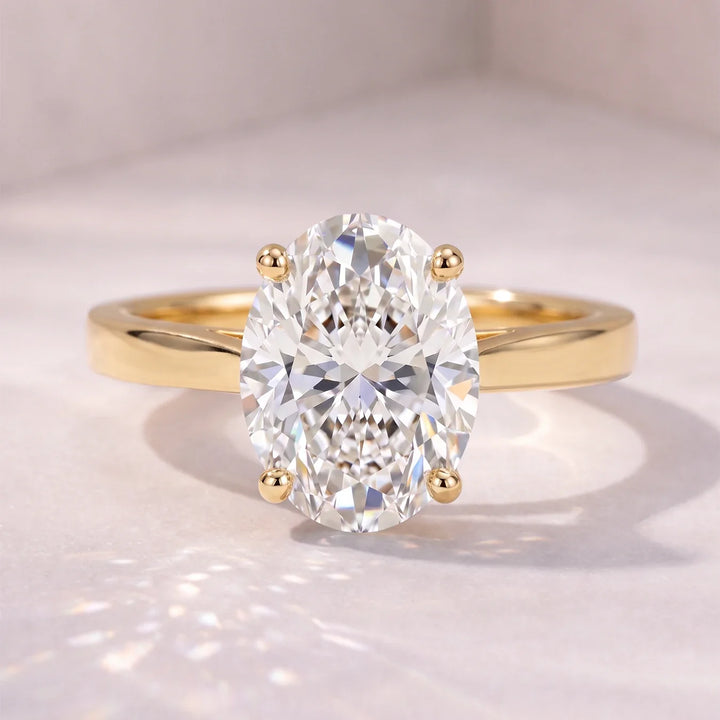
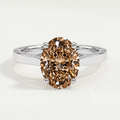
The Paris oval-cut green lab diamond ring shows a rectangular centre framed by four claws and a simple yellow-gold band.
Are Green Diamonds More Expensive?
Compare prices only after checking the diamond’s origin, colour origin or treatment, measurements and report. Two stones described simply as “green diamonds” may have very different reasons for their asking prices.
GIA describes natural-colour green diamonds as extremely rare, particularly those with saturated colour. That natural rarity can carry a substantial premium; it should not be used to imply that every green lab-grown diamond is equally rare.
Colour is an important part of a fancy-colour diamond’s value. Small differences in hue and colour strength can affect price, alongside size, clarity and cut. The most expensive shade is not necessarily the one you will enjoy wearing most.
For a green lab-grown diamond ring, compare current prices for the actual stone and setting you want. A starting price for a design may relate to a different centre stone or metal from the one in its photograph.
For your engagement ring, decide which details matter most: the particular shade of green, the outline of the centre stone or the setting around it. This makes it easier to compare options within your budget.
What Does a Green Diamond Symbolise?
Green often brings nature, growth and renewal to mind. You might choose it as a reminder of somewhere you love, a favourite colour or the life you are building together. None of those meanings has to be shared by everyone else.
These are personal associations, rather than properties of the diamond. A green colour is not evidence of environmental credentials; any sustainability claim needs its own support.
What Colour Diamond Is the Rarest?
There is no useful single ranking without specifying the colour, its strength and whether it occurs naturally. Natural red, blue, pink and green diamonds can all be exceptionally rare, with vivid examples particularly unusual.
That is a different question from which colour makes the best engagement ring. A subtle green may suit you better than a more saturated stone, regardless of its rarity.
The beauty of a coloured diamond can be very personal. Choose a shade you like in ordinary lighting, rather than one that looks impressive only in a highly lit close-up.
Discover Green Lab Grown Diamonds at Lily Arkwright
When comparing green stones, view them face-up and from different angles. Look for any secondary colour you enjoy, and notice how light or dark the stone appears against your preferred metal. Photographs and screens are helpful for a shortlist, but they cannot reproduce colour precisely.
Ask to see the available stone or a representative sample in daylight and indoor light where possible. Confirm which measurements, report and treatment information apply to the stone in your quote.
If you like a clean, straight-edged outline, the Green Lab Diamond Margot Engagement Ring pairs an emerald-cut green lab diamond with a bezel that follows its shape. The plain band leaves the colour and stepped facets in view.

Whether green is a small accent or the centrepiece of your ring, choose the shade and setting together. The ring should feel right on your hand as well as look appealing in a photograph.