









Emerald Engagement Rings: How to Choose and Care for One
Updated 6 November 2026
The appeal of an emerald engagement ring is often immediate: you love the green. Choosing one for daily wear takes a little more thought. Emerald needs protection from knocks, and any treatments can affect how it should be cleaned.
Start with the colour you enjoy, then look at the individual stone, its setting and how the ring will fit your routine. You don’t have to know every gemmological term before you begin, but a few questions will help you make a more informed choice.
Emerald or emerald-cut: what are you looking at?
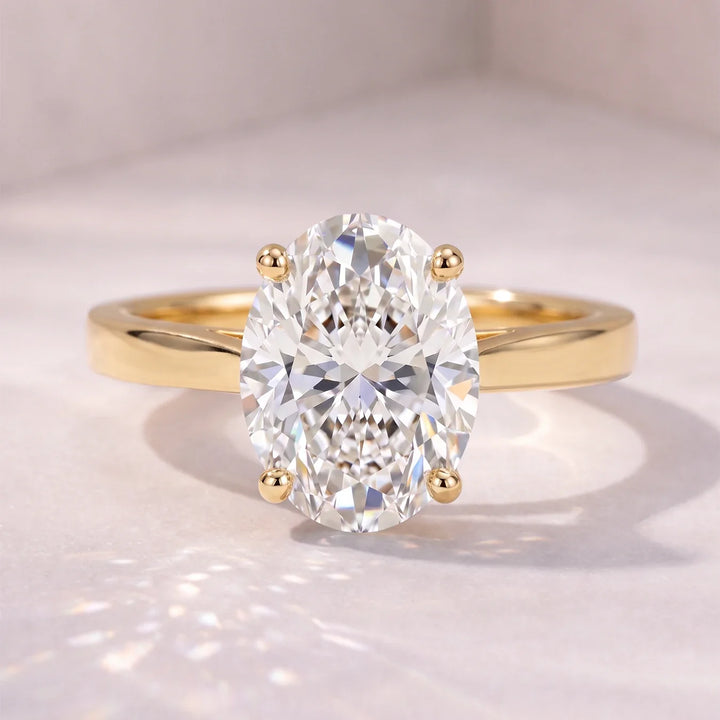
Emerald is the green variety of beryl. “Emerald-cut” describes a cutting style: a usually rectangular outline with clipped corners and stepped facets. A diamond can be emerald-cut without being an emerald, and an emerald gemstone can be cut into an oval, round or square shape.
In a simple solitaire, those differences are easy to see. The Florence Engagement Ring Lily Arkwright pairs a rectangular, emerald-cut lab-grown emerald with a plain 18k yellow-gold band. The uncluttered setting keeps the green centre in view; it’s a useful starting point if colour is what matters most to you.

Lab-grown and natural emeralds
A natural emerald forms in the earth; a lab-grown emerald is created in a laboratory. Lab-grown emerald is emerald, with essentially the same chemical, physical and optical properties as the natural material. It isn’t simply another green stone made to look similar.
Colour, transparency and internal features still vary, so judge the stone you’re considering. Laboratory origin alone doesn’t guarantee better colour, freedom from chips or a particular environmental footprint. If sourcing is part of your decision, ask what the supplier can substantiate about that gemstone.
Look at colour, clarity and treatment together
Some emeralds lean towards a bluish green; others look warmer. View the stone in ordinary daylight as well as indoor lighting, and move it around. A photograph is a helpful introduction, but it can’t show every change in colour or how easily you can see into the stone.
The trace elements responsible for colour are different from the tiny internal features known as inclusions. Emerald’s garden-like pattern of inclusions is sometimes called jardin. Their position and extent matter: some mainly affect appearance, while fractures can also affect durability.
Ask whether the emerald has been treated and what that means for its care. Oils or resins are often used to make surface-reaching fissures in natural emeralds less noticeable. Don’t assume a stone is untreated simply because it is lab-grown, or that every emerald has had the same treatment.
Country of origin can be part of a natural emerald’s story, but it doesn’t replace a close look at the gemstone. Compare colour, transparency, cut and condition, along with any treatment disclosure.
Choosing the shape and setting
A square centre gives a different outline from Florence’s longer rectangle. The Lulu Engagement Ring Lily Arkwright combines a princess-cut lab-grown emerald with a fine platinum solitaire band. If you’re choosing between the two, try similar shapes on and notice which proportions you prefer on your own hand.

A halo brings more detail around the centre and changes the ring’s overall outline. The green-centred example below shows that fuller look. For a different gemstone in a similar style, our Diana Engagement Ring article explores the famous blue sapphire and diamond halo ring.

Look at the side view too. Ask how the setting protects exposed corners or edges, how high the stone sits, and whether it will sit comfortably beside a wedding band. A bezel can offer some protection around the edge, but no setting makes an emerald immune to damage.
Can you wear an emerald ring every day?
Emerald can be worn regularly with thoughtful care. It measures 7.5–8 on the Mohs scale, which describes resistance to scratching. That number doesn’t tell you how well a stone will withstand a knock, and both natural and lab-grown emeralds can chip or fracture.
Be realistic about your day. If you work with your hands, lift weights or garden, you’ll need a safe place to put the ring while you do those things. Ask the jeweller to assess the particular stone and setting for your lifestyle, rather than relying on its origin or hardness number alone.
For cleaning, GIA recommends warm soapy water and gentle scrubbing. Use a soft brush and follow the jeweller’s instructions for the whole ring. Avoid steam and ultrasonic cleaners, high heat and harsh chemicals. Have the setting checked periodically, and stop wearing the ring if a stone feels loose.
What affects the price?
Carat weight is only part of the quote. The emerald’s colour, transparency, cut, origin and treatment matter, as do the metal and any surrounding stones. There’s no useful rule that an emerald must cost more—or less—than a diamond of the same weight.
Compare complete specifications and current prices for the rings you actually like. Ask for the centre stone’s measurements as well as its weight, and check what is included in the price. That gives you a better basis for choosing than a general price-per-carat figure.
A personal reason to choose green
Emerald is the May birthstone, which may give the ring an extra connection to a birthday or a date that matters to you. You might associate green with a favourite place, or simply like it against your skin. It doesn’t need a grand explanation.
Before ordering, ask the team to confirm the centre stone’s identity, any treatments, the setting details and the care it will need. Then give yourself a little time to look at it. The right choice is one whose colour you enjoy and whose care you’re comfortable taking on.