









Diamond Carat Size Guide
Updated 3 November 2026
Carat tells you how much a diamond weighs. It doesn’t tell you exactly how it will look on your finger. One carat equals 0.2 grams; the measurements in millimetres describe the stone’s dimensions.
If you’re choosing the diamond carat size for your engagement ring, start with the shape you like, then compare individual stones. A round diamond and an oval of the same weight can look quite different. Even two rounds with the same carat weight won’t necessarily have the same diameter.
How to read a diamond’s measurements
A diamond report gives you more to work with than the carat number alone. Look for the measurements in millimetres and check which part of the ring the stated weight describes.
| Detail | What it tells you |
|---|---|
| Centre-stone carat weight | The weight of the main diamond, excluding any smaller diamonds in the setting. |
| Round diamond measurements | Minimum–maximum diameter × depth. The diameters help you compare the outline seen from above. |
| Other diamond shapes | Length × width × depth. Compare both length and width: a longer oval may also be narrower. |
| Total diamond weight | The combined weight of all the diamonds in the ring. If a separate figure is given for accent stones, it excludes the centre. |
There isn’t an exact conversion from carats to millimetres. A deeper stone can carry more of its weight below the top surface. For a ring you’re considering, use that diamond’s own measurements rather than relying on a generic size chart.
The same weight can give a different outline
An oval draws the eye along the finger; a round has a more even outline in every direction. A cushion can be fairly square or noticeably elongated. Shape names are a starting point, so it’s worth looking at the proportions of the actual stone.
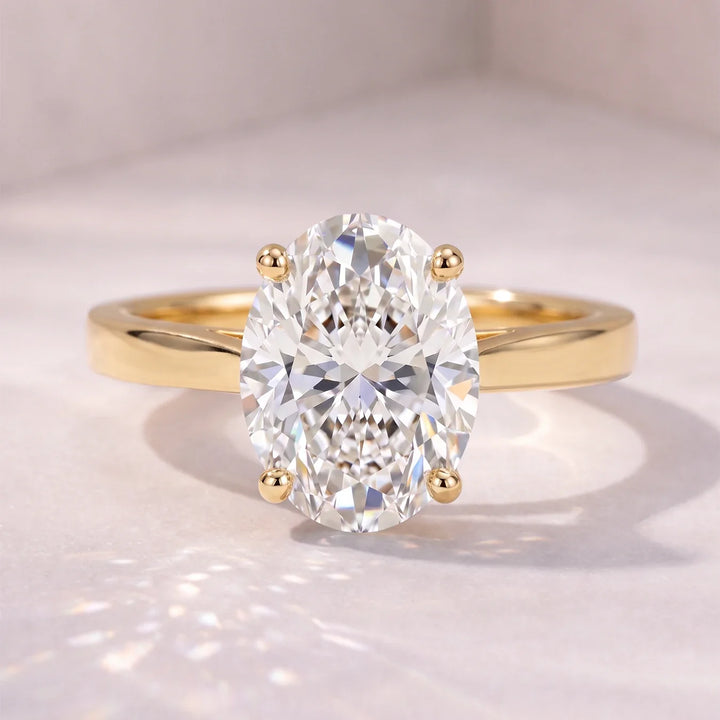
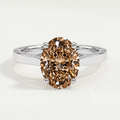
The Isabella’s simple four-claw setting makes its oval centre easy to see. It’s a useful example of how an elongated outline looks in a solitaire, although a photograph can’t show you its true size on your own hand.

Dimensions are only part of the picture. Cut and proportions also affect how a diamond handles light. A wide outline alone doesn’t tell you how lively the stone will look, so compare it in motion and under more than one kind of lighting where possible.
Comparing carat weights without chasing an average
There’s no carat weight you need to aim for. If you’re browsing lab-grown diamond engagement rings and deciding between 2ct and 3ct, compare the measurements of specific diamonds in the same shape. The difference in weight won’t necessarily translate into the same percentage increase in width.
Give yourself room to change your mind when you try rings on. You might enjoy a larger centre than you expected, or prefer a smaller stone with a more substantial band. Neither choice depends on having a particular hand or finger shape.
Carat weight also doesn’t give you the whole price. Cut, clarity, and colour also dramatically influence cost. Compare the details alongside the appearance, rather than treating two equally heavy diamonds as interchangeable.
How the setting changes what you see
A halo around the centre adds to the ring’s overall outline. It doesn’t increase the centre diamond’s own measurements. Pavé shoulders bring small points of sparkle along the band, while a plain solitaire leaves more of the attention on the centre.
Macy shows how a radiant centre works with a fine, diamond-set band. Look at the centre and the shoulders separately: the band contributes to the overall impression even though its small diamonds aren’t part of the centre-stone weight.

For a cushion-shaped centre, one option is the Lily Arkwright Paris 1.00ct Cushion Cut Engagement Ring with a slim yellow-gold band. Its hidden halo sits beneath the stone, adding detail from the side rather than framing it with a visible halo from above. When comparing rings, ask to see the profile as well as the view you’ll see looking down at your hand.

What ring photographs can tell you
Photos are useful for spotting details you like, but separate product photographs aren’t a scale comparison. The hand, viewpoint, cropping, camera distance and your screen all affect how large a stone appears.
You can gather ideas by checking out our Instagram. For a closer look at a particular design, try booking a quick WhatsApp consultation or requesting images directly from our team. Ask for the centre stone’s measurements and, if available, a photograph alongside another identified size on the same hand.
Lottie’s round centre and tapered shoulders are useful details to look for when comparing solitaires. Notice where the band narrows towards the stone, then consider whether you prefer that shape or a more even band width.

The product pages offer different stone options. Check the selected centre weight and measurements when you enquire; a link may open a different option from the one pictured.
See how the ring feels on your hand
Try rings on in our Manchester or London Marylebone showrooms to compare the outline, band width and setting height together. Let the team know which designs and sizes you’d like to see so they can confirm the samples available.
You can also discuss rings via virtual appointments and see details over WhatsApp. That helps with a shortlist, though it won’t tell you how the ring feels to wear. For that, an in-person try-on is more useful.

Think about how the setting sits against neighbouring fingers and whether you’ll wear it beside a wedding band. Ask about care for the particular design, too. A smaller diamond doesn’t automatically mean less upkeep; the setting’s construction and condition matter.
If you’re still exploring, Lily Arkwright’s expansive engagement ring collection lets you compare classic solitaires, vintage styles and chunky band engagement rings. Choose a few you like, note their dimensions and try similar settings where you can. The most useful comparison is the one that helps you decide what you enjoy wearing.