









Created: May 26, 2021
Updated 16 November 2026
A simple engagement ring still gives you plenty to choose between. The claws, shoulders and height of the setting all change how a solitaire looks on your hand. These five designs keep the centre in focus, with details that become clearer when you look from the side.
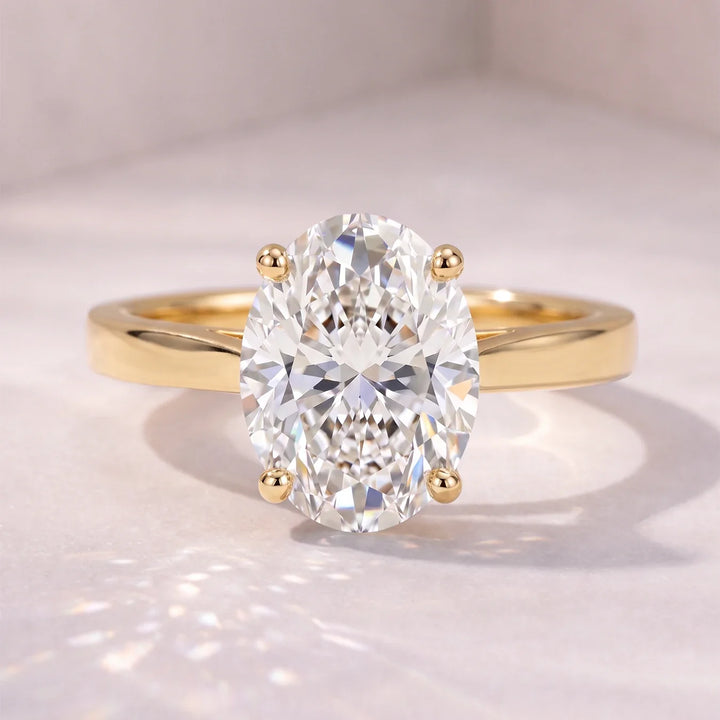
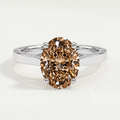
Two Tone Yellow Gold Grace Solitaire pairs a yellow-toned band with a contrasting setting around the centre.
Start with the side view. Grace has a four-claw basket and plain shoulders, giving the centre an open frame. Compare the two-tone photograph with the white-metal example below: changing the metal colour changes the outline without adding more stones.
Grace 1.90ct/ 8mm Moissanite Platinum Solitaire — the side view shows the basket beneath the centre.
A coloured centre changes the same simple design again. The green example below shows how much of the character can come from the stone itself. Check the current specification for the metal, centre material and measurements of the version you choose.
Moissanite carat labels commonly express diamond-equivalent weight, rather than the stone’s actual weight. Use the millimetre measurement when comparing its size.
Grace Lab-Grown Emerald Solitaire — a green centre on a plain band.
Serenity frames its centre with six claws. In the rose-toned example, the band narrows towards the setting, leaving most of the detail around the stone. Look from above and from the side before deciding whether you prefer this outline to the four-claw Grace.
Serenity 1.2ct/ 7mm Moissanite Rose Gold Solitaire — a six-claw setting viewed from the side.
Before ordering, check the delivery estimate and the conditions of the 50-day returns guarantee on eligible purchases for your chosen ring.
Annora’s twist is easiest to see beneath the centre. It adds movement to the side profile while keeping the band free of extra stones. This is a useful comparison if you like an uncluttered view from above but want a little more detail when the ring turns.
Annora Twist 1.2ct/ 7mm Moissanite Solitaire — the shoulders curve into the setting.
If you prefer colour, compare the available coloured gemstones as a separate choice. Confirm which stone and setting combinations can be made rather than assuming every design accepts every shape.
Giselle adds small stones along the shoulders. It may suit you if a plain band feels too spare, but you still want one clear focal point. Compare how far the decoration runs along the finger with the simpler bands above.
Giselle 1.5ct/ 7.5mm Moissanite Platinum Solitaire — small stones follow the shoulders towards the centre.
Paris places a hidden halo beneath the centre stone, so its extra detail is more apparent from the side. The two views below show that difference. When comparing moissanite engagement rings, check the height of the exact stone and setting combination; different centre sizes need not sit at the same height.
A tapered band narrows as it approaches the centre setting. A knife-edge band has a raised ridge along its outer surface. Both change the outline of classic solitaires, but neither guarantees that the stone will look larger. Try the profiles on if possible: a detail you enjoy in a close-up photograph may feel different on your hand.
Lillie 1.50ct/ 7.5mm Platinum Solitaire with a Knife-Edge Band — the ridge gives the band a defined edge.
Notice the amount of metal beside the stone as well as the band’s overall width. Bring photographs of the details you like to a consultation if you are considering a bespoke variation.
Lottie Solitaire with a Tapered Band — the shoulders narrow towards the centre.
A wed-fit setting is designed to leave room for a wedding band alongside it. The final fit depends on both rings: their widths, profiles and any projecting details. Try the intended pair together and ask the team to check for rubbing or a gap. Wed-fit does not mean every wedding ring will sit flush.
Stone identity and appearance are separate questions. Moissanite, laboratory-grown diamond and coloured gemstones offer different looks. Check the description and any accompanying report for the particular stone; laboratory origin alone does not establish its environmental impact.
A round centre has a curved outline; a princess cut brings a square shape to a simple setting. Compare the actual stones in ordinary lighting as well as the close-up photographs. Shape names alone do not tell you which stone you will enjoy wearing.
Three loose round stones shown together on the hand.
The same shape can look different in moissanite and diamond engagement rings. Ask to compare the materials before choosing; a still photograph cannot show every change in the way a stone reflects light.
Yellow and rose gold bring warmer colours, while white gold and platinum offer white-metal options. Compare them beside jewellery you already wear and ask about the upkeep of the chosen finish.
A hallmark verifies precious-metal fineness. It does not grade the gemstone, establish where the ring was made or guarantee the quality of every part of the design.
Check the complete specification and applicable terms for the ring you want. Lily Arkwright is listed by Assay Assured; current trade-association membership can be checked through the National Association of Jewellers . Customer reviews are available on Trust Pilot.
To compare settings or discuss a shortlist, call 0161 537 6773 or email hello@lilyarkwright.com. Bring any ring you plan to wear alongside it so the pairing can be considered together.