Choosing your lab grown gemstone engagement ring
Start with the gemstone, not just its colour
Lab grown sapphires, rubies, emeralds and alexandrites have the same essential chemical composition and crystal structure as their natural counterparts, but are grown in controlled conditions rather than mined. They are not simply coloured imitations of those gemstones. Individual stones can still differ in colour, clarity and appearance, so choose the material and the particular stone together.
Sapphire offers a palette from deep blue to pink, yellow and pink-orange padparadscha tones. Emerald provides a green centre, ruby brings red, and alexandrite changes appearance with the light. Compare photographs or video in different lighting to judge the colour you will enjoy wearing. In our Aquamarine Blue and Morganite Pink ranges, those names describe sapphire colours: the stones are sapphire, not aquamarine or morganite beryl.
Choose the outline and setting together
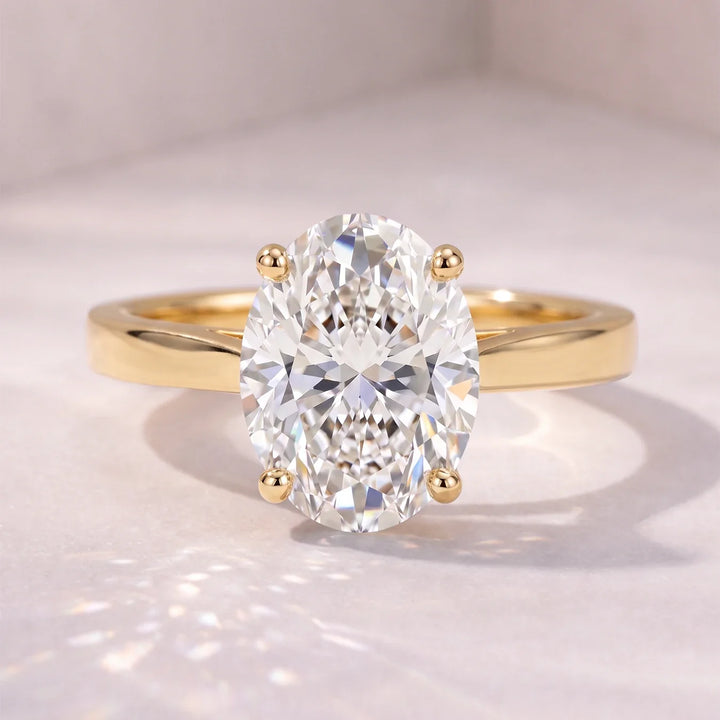
Round gemstone rings give the centre a balanced outline, while oval gemstone rings add softly elongated curves. Emerald-cut gemstone rings offer a rectangular outline with stepped facets. Emerald cut describes the shape, not the gemstone: an emerald-cut ring need not contain a green emerald.
A gemstone solitaire leaves the centre as the main focus. A halo adds a visible frame, a trilogy creates a three-stone composition, and shoulder-set designs introduce detail along the band. Check the material and dimensions of any accent stones separately from the centre.
Compare size and the complete proportions
Carat measures weight, not the area visible on your hand. Different gemstone materials and cutting proportions can produce different dimensions at the same weight. Compare length and width in millimetres, the band width and the full setting. A halo adds to the outline without changing the centre stone's weight. Check which size appears in the photographs and examine the side profile for setting height and wedding-band clearance.
Find your metal and make the design personal
Platinum and white gold create a pale frame around colour; yellow gold introduces warmth, while rose gold adds a pink tone. Compare the same gemstone in the metals available for your preferred design. Consider the band and claws as well as the centre, and confirm ring size and wedding-band fit before ordering.
For a different combination, explore our bespoke ring service. Our team can discuss the options, price and timing for your chosen design, or help you compare rings at our London showroom or Manchester showroom.
Choose care that suits the gemstone
Sapphire and ruby resist scratching well, but no gemstone or setting is immune to damage. Emerald generally requires more care around impact and cleaning. Alexandrite also needs protection from hard knocks. Hardness describes scratch resistance, not every aspect of durability; the selected stone, any treatments and the mounting all matter.
Remove your ring for sport or heavy manual work and follow the care advice for the complete piece. Our emerald engagement ring guide explains emerald-specific care. For a closer look at the blue range, read our blue sapphire engagement ring guide.