











Shipping
Lily Arkwright are proud to offer Free worldwide delivery & returns.
Postage Timescales:
UK: Next day delivery
Europe: 2-5 days delivery
US & Canada: 3-5 days delivery
Rest of World: 3-5 days delivery
All parcels are shipped via our nominated couriers and are fully insured to your postal address, every parcel requires a signature upon delivery. No customs, duty or tariffs are payable for any deliveries worldwide. The price you see, is the price you pay with no additional fees.
Returns
All Return Postage is FREE
When sending items back please ensure you obtain proof of postage. When returning your order please request a RETURNS NUMBER (RN) by emailing hello@lilyarkwright.com.
We offer a 50-day money-back guarantee from the date of delivery. All returned items must be in an unworn condition with all original packaging and relevant certificates.
We do not accept returns or exchanges for engraved, personalised, bespoke/made to order items and purchases over £15,000 unless faulty or otherwise agreed in writing. For more information please view our Delivery & Return info.
A little bit more sparkle perhaps?
You've found your near perfect Lily Arkwright ring, but there's something missing.
Rather than creating a bespoke ring design, simply select any of our popular ring upgrade packages from pointed prongs to a hidden diamond halo, we've got you covered.
View all upgrades here.
Matching Wedding Band
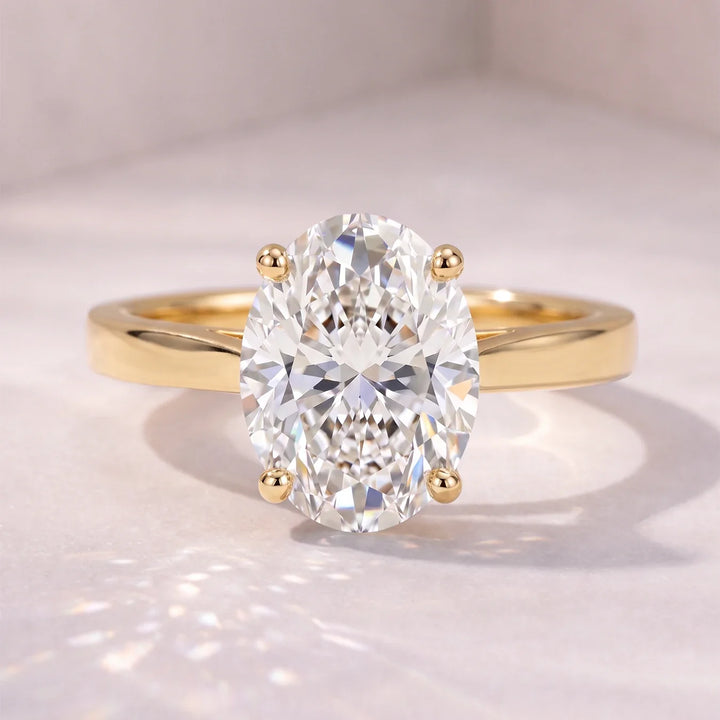
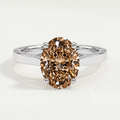
We recommend you match the Lulu Engagement Ring with the Cecelia 1.65mm Wedding Band.

LONDON - MANCHESTER
Book an Appointment
Step into the world of Lily Arkwright, we offer virtual WhatsApp appointments. Alternatively, visit our London or Manchester showrooms to find your perfect Diamond Ring.
Book your appointment, Click Here.
Payment Options
Klarna 0% Interest Available
Simply choose Klarna during checkout and select your preferred payment option, Pay in 30 days, Pay in 3 or monthly instalments between 0 - 36 months, starting from 0%.
For more details, Click Here.
Speak To An Expert
We're Here To Help
Our consultants have a wealth of knowledge and passion to help you choose the perfect ring.
See our FAQ's or Get In Touch
Certified






Recently viewed
ABOUT YOUR CENTRE DIAMOND
White lab-grown diamonds
A white lab-grown diamond places light at the centre of your engagement ring. Its appeal lies in a bright, largely neutral appearance that lets the shape of the stone and the details of the setting come into focus. Whether your preference is a simple solitaire, a delicate halo or a balanced trilogy, a white diamond offers a starting point for a ring that feels entirely your own.
Choosing white rather than a coloured centre stone is a design decision, not simply a default. It creates a different relationship between the diamond, its setting and any surrounding stones: one led by brightness and contrast rather than a distinct pink, yellow, green or blue hue.
What is a white lab-grown diamond?
A laboratory-grown diamond is diamond, rather than a diamond imitation such as cubic zirconia. It has essentially the same chemical composition, crystal structure and physical properties as a natural diamond. The distinction is its origin: it is grown in controlled conditions rather than formed through geological processes underground.
Two principal production methods are high pressure, high temperature, known as HPHT, and chemical vapour deposition, or CVD. Both produce diamond crystals that can be cut and polished for jewellery. Growth method alone does not tell you how attractive a finished diamond will be; the individual stone still needs to be assessed.
The word “white” describes a familiar appearance, rather than one precise colour grade. White diamond jewellery can include colourless and near-colourless stones, with subtle differences in warmth. It should not be taken to mean that every white lab-grown diamond is completely without colour.
Understanding colour, clarity and carat weight
Where a diamond is described using the conventional D-to-Z colour scale, D–F sit within the colourless category and G–J within the near-colourless category. These distinctions concern the diamond’s body colour, not the rainbow flashes it can produce as it moves in the light.
Clarity describes internal inclusions and surface characteristics. A clarity grade is useful, but it is not a substitute for looking at the diamond. The position, size and visibility of individual characteristics matter when considering how the stone appears without magnification.
Carat measures weight, not face-up dimensions. Two diamonds of the same weight can have different outlines and measurements because their proportions differ. Consider the millimetre dimensions alongside the carat figure, especially when comparing different shapes.
Together, these details help you make a more considered choice than selecting the largest available carat weight. Your Lily Arkwright ring should feel balanced on your hand, with a centre stone whose appearance you enjoy at an ordinary viewing distance.
Why shape and cut deserve separate attention
Shape describes the outline of the diamond: round, oval, pear, cushion or another form. Cut concerns its proportions and faceting, and how those features interact with light. A familiar outline does not guarantee identical sparkle from every diamond of that shape.
An oval offers a different silhouette from a round stone; a pear introduces a directional point; a step-cut design presents a different pattern of reflections from a brilliant-style cut. These are visual choices to explore, rather than a hierarchy in which one shape must be best.
For oval diamonds, compare the balance between length and width and observe how light and darker areas move across the stone. A video or viewing can help you assess its overall character rather than relying on a single carefully lit photograph.
For a white centre stone, think about the quality and pattern of light you enjoy: lively flashes, a broader reflective appearance, or a particular outline that complements your chosen setting.
Choosing the setting and metal
White diamonds leave considerable room for personal styling. Platinum or white gold can create a coordinated, cool-toned composition. Yellow gold introduces a warmer frame, while rose gold offers another contrast between the metal and the centre stone.
A solitaire keeps attention on the outline of the diamond. A halo creates a more decorative border. In a trilogy, the relationship between the centre and side stones becomes part of the design: their shapes, spacing and proportions determine whether the composition feels delicate or more substantial.
Think beyond the view from above. The height of the setting, the side profile, the width of the band and the fit beside a wedding ring all deserve consideration. A ring that looks appealing in a close-up should also feel right as a complete piece of jewellery.