


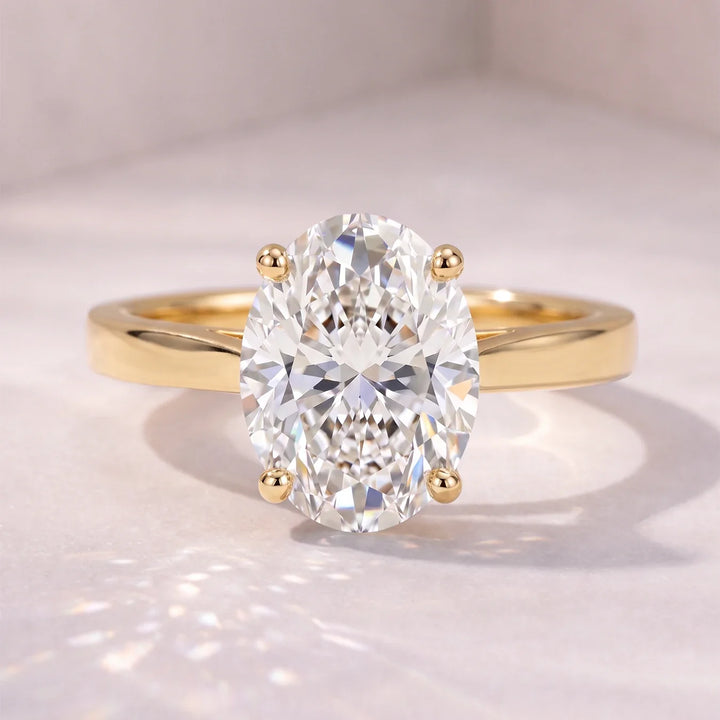


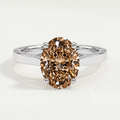


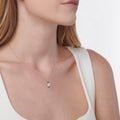





SLOANE - Pear Blue Lab Diamond 18k White Gold Petite Solitaire
The centre leads the design. Compare its dimensions, claw arrangement and basket above the band.
View this designColoured lab-grown diamond engagement rings bring extraordinary personality to a classic diamond centre. Explore pink, yellow, blue and green diamonds alongside champagne and deeper tones, set in platinum and gold. From refined solitaires to delicate halos and detailed shoulders, the setting frames each shade differently. Choose by the diamond's actual hue and proportions as well as its cut.


Begin with the colour you enjoy in neutral light, then compare individual stones in that family. Tone, distribution, outline and viewing conditions can affect their appearance. Use the specific colour collections to refine a shortlist rather than expecting every pictured centre to be identical.
These are laboratory-grown diamonds with deliberately coloured appearances. Growth and post-growth treatment information can vary, so read the selected stone’s report and available supplier disclosure. A famous mined coloured diamond does not establish the origin or rarity of a lab grown centre.
Compare warm and cool metals, plain bands and diamond-detailed mountings. Use both the centre dimensions and total setting width when assessing the ring on the hand. Keep the complete specification consistent when comparing prices.
The centre leads the design. Compare its dimensions, claw arrangement and basket above the band.
View this design
Three stones form the composition. Compare their individual shapes, proportions and the complete setting span.
View this designWe’re proud to be recognised consistently by the UK jewellery industry’s leading awards programmes. In 2026, Lily Arkwright has been shortlisted for Branded Boutique of the Year at the Professional Jeweller Awards and Bridal Jewellery Retailer of the Year at the UK Jewellery Awards, reflecting our continued commitment to exceptional customer service, product innovation, and ethical craftsmanship.
These latest nominations build on previous industry recognition, including being shortlisted for Bridal Jewellery Retailer of the Year at the 2025 UK Jewellery Awards and Independent Retailer of the Year at the Professional Jeweller Awards 2025. We were also finalists for Retail Team of the Year at both the Retail Jeweller Awards and Professional Jeweller Awards in 2024, recognising the passion, expertise, and dedication of our team.
We’re honoured to be recognised for helping thousands of couples find the perfect engagement rings and wedding rings, with a strong focus on choice, transparency, and personalisation. As an award-winning jeweller, we remain committed to delivering exceptional service, exceptional craftsmanship, and responsibly sourced lab-grown diamonds, moissanite, and natural diamonds, ensuring every customer can find a ring that perfectly reflects their love story.
At Lily Arkwright, Community Matters Lily Arkwright’s roots lie in leafy Didsbury, Manchester. While we have grown into one of the UK’s leading fi...
Read moreThis year marks Lily Arkwright's 5th year of supporting Unicef during Black Friday building upon our successful 2019 Unicef Halloween Ball partne...
Read moreBoth coloured and white lab-grown diamonds are diamonds, but with coloured centres we'd pay more attention to hue, strength of colour and how evenly that colour appears. A delicate pink and a rich blue can create very different engagement rings even at the same carat weight. The cut and metal setting matter too. If you prefer the traditional colourless look, our lab-grown diamond engagement rings offer a useful comparison.
Not every coloured lab-grown diamond has the same treatment history. Some acquire colour during growth, while others may be treated afterwards to create or alter a shade. We'd look at the details and any identification or grading document for the actual stone rather than assume that blue, pink or green diamonds all behave alike. Our team can talk you through what is disclosed for a particular centre and how its colour looks in different lighting.
We'd begin with the shade that feels most personal to the wearer. A soft pink can be understated, while a saturated blue or yellow makes a more obvious statement; champagne and brown tones bring warmth. Then we'd compare the individual stones in natural and indoor light and look at them against the precious metal. There's no single 'best' colour. The important thing is finding one you'll enjoy seeing every day.
A coloured lab-grown diamond is still diamond, whereas sapphire is a different gemstone made of corundum. They can sometimes offer similar hues, but their sparkle, colour character and prices can differ. We'd compare actual stones rather than choosing by colour name alone. If you're drawn particularly to blue, pink or yellow, our lab-grown sapphire rings provide another way to explore those shades in an engagement-ring setting.
With a coloured diamond, we'd suggest reading the identification or grading document for the exact stone. Look for the laboratory, measurements, colour description and any notes on colour origin or treatment. Reports aren't always formatted the same way, so it's important to understand what each document does and doesn't state. We'd also judge the stone in person or through reliable imagery; two diamonds with similar colour wording can look quite different in daylight.
Our jewellery specialists would be delighted to help you compare designs at our London or Manchester showrooms, or in a virtual consultation.


