









Updated 12 November 2026
January 11, 2021
Choosing Your Moissanite Ring - Comparing Cuts
Choosing a moissanite engagement ring starts with the shape you enjoy looking at. A round stone, a long oval and a square step cut can feel quite different on the hand, even at a similar size.
Shape means the outline seen from above. Facet style describes the arrangement of the polished surfaces, while cut quality concerns how well those surfaces are proportioned and finished. Shops often use “cut” for all three, so it helps to know what you are comparing.
Use the shapes below to narrow your choice, then compare the actual measurements, a moving video and the setting. A shape name alone cannot tell you how a particular stone will look.
A round brilliant has a circular outline and many small facets that break light into bright flashes. Its balanced shape is a useful starting point if you are unsure which style you prefer.
Look at the stone as it moves, rather than judging it from one bright photograph. Avoid treating a diamond cut grade as a universal grade for moissanite; ask what any quality description means for the particular stone.
The Giselle below combines a round centre with a stone-set band. It shows how the setting can add detail without changing the outline of the centre stone.
Photo Reference: Giselle 1.20ct Round Cut Moissanite Ring
Hearts and Arrows Cut
Hearts and arrows describes a symmetrical reflection pattern, rather than a separate gemstone shape. Under a suitable viewer, the hearts are seen from beneath the stone and the arrows from above.
The pattern can help illustrate optical symmetry, but it does not replace looking at the stone in ordinary lighting. It also does not make moissanite a diamond.
The plain band of Grace keeps the attention on its round centre. If you specifically want hearts-and-arrows moissanite, check the available stone specification rather than assuming every round version has that pattern.
Photo Reference: Grace 1.90ct Moissanite Platinum Ring
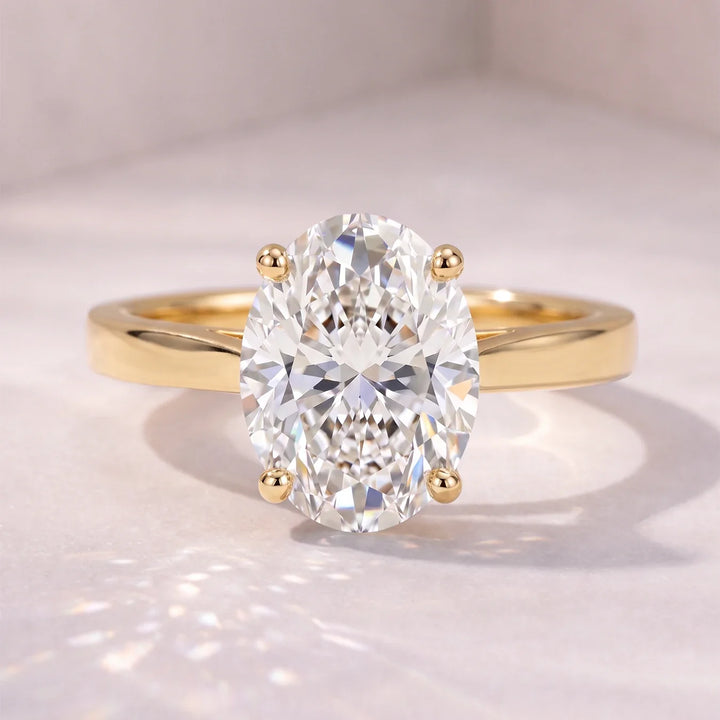
Oval Cut
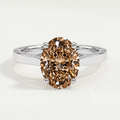
Oval stones have a longer outline with rounded ends. Some are broad and softly rounded; others are noticeably slender. Length and width in millimetres tell you more about that outline than a weight label alone.
An oval can show a darker bow-tie area across its centre. Its appearance depends on the individual stone and viewing conditions, not a simple rule that shorter or longer ovals are always better. Watch a moving video to see how prominent it is.
The Macy petite pavé white gold shoulder set ring pictured below pairs an oval centre with a fine stone-set band. Compare that more detailed look with Isabella engagement ring to decide how much you want the band to contribute to the design.
Photo Reference: Macy Oval Cut Moissanite White Gold Shoulder Set Ring
Princess Cut
Princess cuts are usually square, with pointed corners and brilliant-style facets. They offer a more angular outline than a cushion. Compare the symmetry and corner protection in the finished setting, rather than relying on one facet count or a rigid length-to-width rule.
If you plan to wear two rings together, consider the complete pairing. A band such as the Harper Channel Set Platinum Eternity band will sit differently beside a raised solitaire than beside a lower setting.
The moissanite princess cut Rosalee in yellow gold offers a simple way to frame the square centre. Lulu, pictured below, showcases another style for comparison.
 Lulu Princess Cut Moissanite Platinum Ring
Cushion Cut
A cushion combines a square or rectangular outline with rounded corners. Facet patterns vary: some show larger, more distinct flashes, while others have a busier appearance. Two cushions with similar measurements can therefore look quite different.
The Caseada below shows how a halo changes the overall outline around a cushion centre. Decide whether you prefer that framed effect or a simpler setting before choosing the size.
The same outline can also work in a coloured gemstone ring; our guide to gemstones explains the different materials. Shape and gemstone are separate choices.
For a more angular comparison, the Florence engagement ring has an emerald-cut centre rather than a cushion. If the rounded halo look appeals more, Ophelia is another design to consider.
Photo Reference: Caseada Cushion Cut 1.70ct Moissanite Ring
Pear Cut
A pear has one rounded end and one point. Its balance depends on the curve of the shoulders, the length and the position of the point. Check that you like the outline from above and that the setting protects the tip.
Like an oval, a pear may show a bow-tie area. A moving view is more useful than a single photograph for judging it. There is no compulsory direction to wear the point; try both and choose the one that feels right.
The Sloane moissanite ring below keeps the pear outline easy to see on the hand.
 Sloane Pear Cut Moissanite Yellow Gold Ring
Radiant Cut
A radiant has a square or rectangular outline with cropped corners and brilliant-style faceting. It is not a step cut: its lively pattern of reflections is different from the broader flashes of an emerald cut.
In the Iris ring pictured below, the side view shows how high the centre sits above the band. That profile matters when you are thinking about comfort and a wedding-ring pairing.
If you prefer a frame around the centre, compare Esme engagement ring. A halo changes the look and footprint of the whole ring, so do not judge size by the centre stone alone.
Photo Reference: Iris 1.80ct Moissanite Ring
Emerald Cut
Emerald cut refers to a rectangular step cut with cropped corners, not necessarily an emerald gemstone. Its long facets give broad flashes and a more open view into the stone than a busy brilliant-style pattern.
Look at the centre in different lighting and check that you enjoy its balance of bright and dark reflections. The open appearance makes the individual stone particularly important; a shape name is not a guarantee of clarity or sparkle.
Evalina shows one way to frame an emerald-cut centre with smaller surrounding stones.
The Florence lab-grown emerald ring pictured below illustrates the same cut in a green emerald. It is a coloured-gemstone example, not moissanite. The distinction matters when comparing the appearance and care needs of different rings.
Photo Reference: Florence Emerald Cut Emerald Ring
Asscher
An Asscher has a square outline with cropped corners and step-cut facets. Seen from above, those facets create a more concentric pattern than the long lines of a rectangular emerald cut.
Step cuts still sparkle, but their larger flashes look different from the many small reflections of a brilliant style. The example below is useful for seeing that pattern; compare a moving view before deciding which effect you prefer.

Baguette
Baguettes are narrow step cuts, often used as side stones. Straight baguettes have parallel sides, while tapered versions narrow towards one end. They can add clean lines beside a round or other shaped centre.
The ring below pairs a round centre with tapered baguettes. Interested in a different combination through our bespoke package? Start with the shapes you like, then discuss the proportions and practical setting options.
Photo Reference: Bespoke 1.92ct Round and Tapered Baguette Moissanite Platinum Ring
Why Lily Arkwright?
When you compare moissanite engagement rings, bring the choice back to the ring you will wear: its outline, its height, how it feels beside another band and how its reflections look in everyday light.
If you need help narrowing the options, email hello@lilyarkwright.com with the shapes and dimensions you are considering. Ask for the details of the particular centre stone and setting, including any accent stones, before making your decision.
POPULAR READS:
Which shape do you keep coming back to? If you have a question about comparing cuts, leave it in the comments below.