









IGI vs GIA: Diamond Grading Reports Explained
Updated
A diamond report helps you understand the stone you are buying: its identity, measurements and assessed quality. Whether it will be the centrepiece of an engagement ring or another piece of jewellery, it is worth reading the paperwork before you decide.
IGI, the International Gemological Institute, and GIA, the Gemological Institute of America, both examine natural diamonds and lab grown diamonds. Their current lab-grown documents present the results differently. The useful comparison starts with the report for the actual stone, rather than the laboratory’s name alone.

The Lily Arkwright Grace Ring shown here has a round centre and a plain band.
What does a diamond report tell you?
A report identifies the diamond and records characteristics such as its shape, measurements and weight. Depending on the service, it gives individual grades or an overall quality assessment. Read the comments as well as the headline result: they can include information about growth or treatment.
The 4Cs are carat weight, colour, clarity and cut. Cut information needs particular care when you compare diamond shapes and sizes, because an overall cut grade is not supplied in the same way for every shape and report type. Shape describes the outline; cut concerns how the stone has been fashioned.
If you are still deciding between natural and laboratory-grown origin, our lab-grown vs natural diamond guide explains the distinction. The origin should be clearly identified on the document accompanying your diamond.

The Lily Arkwright Florence Ring illustrates a rectangular, step-cut outline in a simple setting.
How IGI and GIA report lab-grown diamonds now
On smaller screens, scroll across to compare all columns.
| Service | How results are presented | What to check |
|---|---|---|
| IGI laboratory-grown diamond report | Applicable 4Cs assessments and identifying information. | The individual report, including shape, measurements and any growth or treatment comments. |
| GIA quality assessment for eligible colourless to near-colourless lab-grown diamonds | An overall Premium or Standard assessment. | The report date and service; these categories are not direct substitutes for separate colour and clarity grades. |
| IGI laboratory-grown jewellery report | An assessment of the mounted jewellery, with centre-stone measurements and 4Cs as the mounting permits. | Which stones are covered and what the mounting prevents the laboratory from assessing. |
IGI laboratory-grown diamond reports
IGI’s report guidance describes the 4Cs alongside the diamond’s origin, shape, cutting style and measurements. Cut information depends on the shape and service. Read the individual document rather than assuming that every report contains the same fields.
IGI also assesses finished jewellery. Its laboratory-grown jewellery report gives centre-stone measurements and 4Cs assessments as the mounting permits. That is different from examining an unmounted diamond, so check which type of report you have.
GIA laboratory-grown diamond assessments
On 1 October 2025, GIA changed its service for colourless to near-colourless lab-grown diamonds. Eligible stones receive an overall assessment of Premium or Standard, based on a combination of quality criteria. A stone that does not meet the minimum Standard criteria does not receive this assessment.
The current service covers loose lab-grown diamonds weighing at least 0.15 carats. Premium and Standard are overall categories, not direct substitutes for an individual colour or clarity grade. Earlier GIA lab-grown reports may use the previous format, so check both the date and the report type.
This change does not apply to GIA’s natural-diamond grading reports. GIA also lists separate services for coloured lab-grown diamonds. Avoid applying one document’s format to every diamond GIA examines.

The Lily Arkwright Blossom Trilogy Ring has a round centre and two smaller side stones. Ask which stones the accompanying reports cover.
How to check a report before buying
Use the laboratory’s own verification service: IGI Verify Your Report or GIA Report Check. Compare the online record with the document you have been given, including the report number, shape, weight and measurements.
If the diamond has a laser inscription, a jeweller can help check it under magnification. Finding a report online confirms that the record exists; matching it to the physical stone is a separate step. For a ring with several stones, a centre-stone report should not be read as an individual grade for every smaller stone.
A grading report is not a monetary valuation or a promise about resale value. If you need documentation for insurance, ask your insurer what it requires and check what is supplied with the ring. Our prices and value guide separates the retail price, replacement valuation and resale offer.
Keep the paperwork and the design in perspective
A report helps you compare characteristics, but it cannot tell you how a ring feels on your hand. Look at the proportions, the way the stone appears in different light and how the setting fits your day-to-day life.
The material matters too. Lab-grown coloured gemstones and moissanite are different choices from diamond, so diamond grading terminology should not be applied to them automatically.

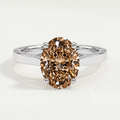
The Lily Arkwright Allure Ring pairs an oval centre with smaller stones along the shoulders.
What to ask when choosing a Lily Arkwright ring
Before ordering, ask which report accompanies the diamond you have selected and which stones it covers. If you prefer a particular laboratory, discuss that preference before choosing rather than assuming every configuration is available with either report.
An online or in-person consultation gives you time to go through those details alongside the ring design. Ask about any report entry you do not understand, including fluorescence or comments about treatment, and compare the document with the particular stone being offered.

The Lily Arkwright Elongated Cushion Lulu Ring keeps an elongated cushion-shaped centre on a plain band.
A grading report does not, by itself, verify a promise of ethical sourcing, sustainability, and outstanding quality. For sourcing questions, ask what separate evidence is available for the ring. Knowing what the document covers—and where its limits lie—makes it a more useful part of your decision.