




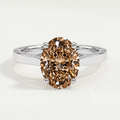


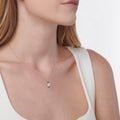



Diamond Shapes and Sizes: Carat Weight and Measurements
Updated
You might love an oval in a close-up photograph, then find yourself drawn to a round diamond when you try rings on. That is a useful part of choosing. Shape, measurements and setting work together, and a carat figure cannot tell you how a ring will look on your hand.
At a glance
- Shape describes the outline; cut quality describes how the stone has been fashioned and handles light.
- Carat is weight. Compare the actual length, width and depth to judge physical size.
- Try shapes in comparable settings and check the ring’s side profile as well as its top view.
Shape, cut and carat mean different things
Shape is the outline you see from above: round, oval, pear and so on. Cut style describes the arrangement of the facets, while cut quality concerns how well the diamond has been fashioned and how it handles light. A shape name alone is not a quality grade. Read the diamond 4Cs guide for cut quality, colour and clarity.
Carat measures weight. One carat is 0.2 grams. Millimetres describe physical dimensions, including length, width and depth. Two diamonds with the same weight can have different outlines and measurements, so compare the actual stones rather than treating a weight as a fixed size.

Start with the outline
Pick two or three shapes you are drawn to, then compare individual examples. These descriptions are starting points, not rules about which shape suits a particular hand.
The links in this table show each shape in our lab-grown diamond collection. The outline descriptions also apply to natural diamonds.
On smaller screens, scroll across to compare all columns.
| Shape | Outline and light pattern | What to compare |
|---|---|---|
| Round brilliant | Circular outline; brilliant-style facets. | Diameter, light performance and balance in the setting. |
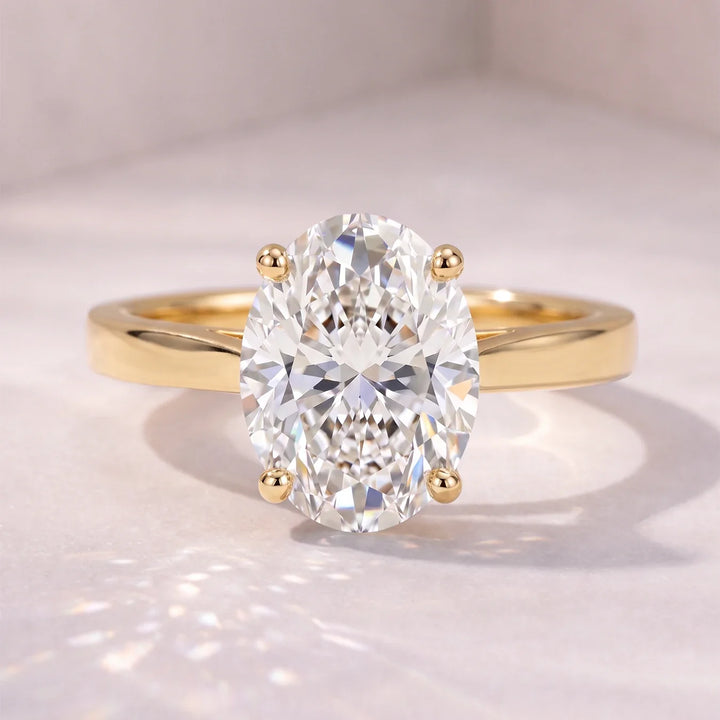
| Oval | Rounded, elongated outline. | Width as well as length; any bow-tie (a darker band across the centre). |
| Pear / marquise | One pointed end / two pointed ends. | Outline symmetry and protection for the points. |
| Emerald / Asscher | Clipped corners and step-cut facets. | Broader flashes of light and the view through the centre. |
| Princess / radiant | Angular outlines with brilliant-style facets; radiant corners are clipped. | The individual outline and facet pattern, plus corner protection. |
| Cushion / elongated cushion | Square or elongated with rounded corners. | How broad or long the outline feels; facet patterns vary. |
There is plenty of variation within each group. Our diamond shapes and cuts guide looks more closely at the individual styles.
Read the measurements alongside the weight
For an elongated diamond, length and width help you picture its footprint on the finger. The length-to-width ratio describes its proportions: dividing length by width shows whether that particular oval or rectangle is relatively broad or slender. It does not tell you whether the diamond is well cut.
For an illustrative example, take an oval measuring 8 × 6 mm. Its length-to-width ratio is 8 ÷ 6 ≈ 1.33. These are example measurements, not those of either ring pictured here.
Depth matters too. Weight carried deeper in a diamond does not necessarily add to the area you see from above. Equally, choosing the widest-looking stone without considering its light performance can be disappointing. Look at the whole diamond, moving it through different angles, rather than selecting from measurements alone.
Photographs need context. Ask whether two images were taken at the same scale, and check the stone’s actual dimensions. A close-up on a different hand is useful for seeing a design, but cannot show exactly how large it will look on yours. Our diamond carat size guide covers the weight decision in more detail.

See the shape in a setting
A plain solitaire makes the centre stone’s outline easy to follow. A halo adds a separate border of smaller stones, while side stones change the spread of the whole ring. Check whether a quoted carat weight describes the centre diamond or the total across the ring. Our ring styles and settings guide shows how those designs differ.
The profile is worth a look as well. A ring can appear delicate from above and sit higher than you expected from the side. Compare band width, the position of the setting and how it feels beside a wedding ring. For pointed shapes and corners, ask how the setting protects those areas.
Make a comparison you can trust
Try your shortlisted shapes on the intended finger, ideally in reasonably similar settings. Look in ordinary indoor light as well as bright display lighting, and move your hand. Notice the pattern of bright and dark areas, not just the brightest flash in a photograph.
A bow-tie can appear in ovals, pears and marquises. How noticeable it is varies with the stone, lighting and viewing angle. A single still image is a poor way to decide whether it bothers you.
Read the individual diamond’s report and ask what its grades cover. A polish or symmetry grade is not automatically an overall cut grade. If you are comparing remotely, request a video of the actual stone and its measurements rather than relying only on a representative product photograph. The diamond grading reports guide explains the different documents and their scope.
Questions about diamond size
Which shape looks biggest?
There is no reliable winner for every pair of diamonds. Elongated outlines can give a different impression of coverage, but compare the actual length, width and proportions. The setting and your own hand also affect what you notice.
Does a two-carat diamond look twice as big as a one-carat diamond?
It has twice the weight. That does not mean twice the length, width or visible area. Dimensions change with shape and proportions; use the measurements of the stones you are considering.
Is diamond size the same as ring size?
No. Diamond dimensions describe the stone; ring size describes the fit of the band on your finger. Our ring size guide helps you check the fit before ordering.
If you would like to compare a few designs, book a jewellery appointment and tell the team which shapes interest you. Ask about sample availability before travelling, especially if you have a particular ring in mind.