











Shipping
Lily Arkwright is proud to offer free worldwide delivery and returns.
We aim to dispatch most orders within 7–28 days. Selected bespoke designs may take 5–6 weeks.
Estimated delivery times after dispatch:
- UK: Next working day
- Europe: 2–5 working days
- US & Canada: 3–5 working days
- Rest of the world: Typically 3–5 working days
All parcels are dispatched through our nominated couriers, fully insured and requiring a signature upon delivery.
Returns
Enjoy a 50-day money-back guarantee with complimentary worldwide return postage on eligible purchases, starting from the date of delivery.
To arrange a return or exchange, please email hello@lilyarkwright.com to request a Returns Number (RN) and return instructions. Please retain proof of postage.
Returned jewellery must be unworn, in its original condition and accompanied by its original packaging and relevant certificates.
Certain engraved, personalised or genuinely bespoke pieces may be excluded from change-of-mind returns, without affecting statutory rights.
For orders exceeding £15,000, the change-of-mind returns period is 14 days rather than 50 days, without affecting your statutory rights.
Please see our Delivery & Returns Policy for full details.
A little bit more sparkle perhaps?
You've found your near perfect Lily Arkwright ring, but there's something missing.
Rather than creating a bespoke ring design, simply select any of our popular ring upgrade packages from pointed prongs to a hidden diamond halo, we've got you covered.
View all upgrades here.
Matching Wedding Band
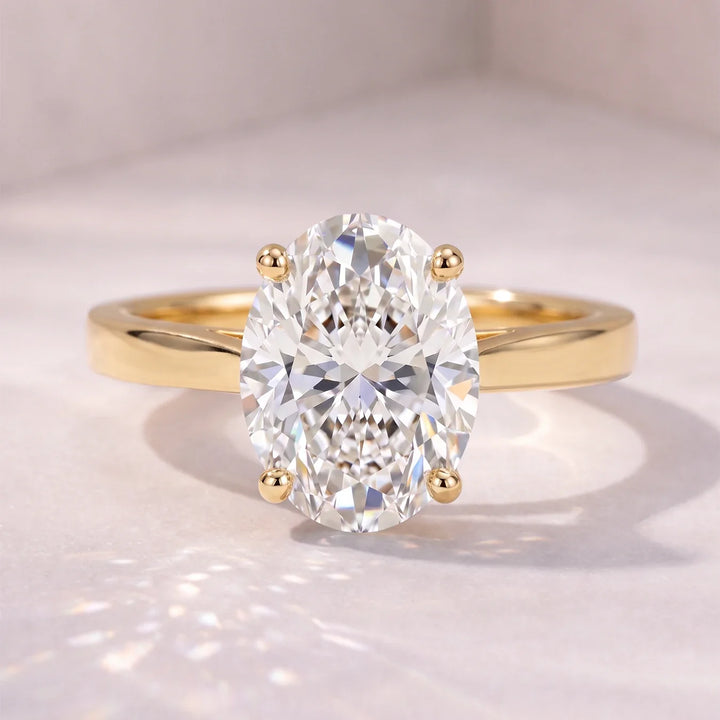
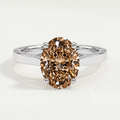
We recommend you match the Everdeen Engagement Ring with the Ember 2.20mm Wedding Band.
LONDON - MANCHESTER
Book an Appointment
Step into the world of Lily Arkwright, we offer virtual WhatsApp appointments. Alternatively, visit our London or Manchester showrooms to find your perfect Diamond Ring.
Book your appointment, Click Here.
Payment Options
Klarna 0% Interest Available
Simply choose Klarna during checkout and select your preferred payment option, Pay in 30 days, Pay in 3 or monthly instalments between 0 - 36 months, starting from 0%.
For more details, Click Here.
Speak To An Expert
We're Here To Help
Our consultants have a wealth of knowledge and passion to help you choose the perfect ring.
See our FAQ's or Get In Touch
Certified






Recently viewed
ABOUT YOUR CENTRE DIAMOND
Green lab-grown diamonds
A green lab-grown diamond introduces a different focal point to an engagement ring. For someone who is drawn to green, it offers a way to make that preference central to the design while choosing a diamond rather than another green gemstone.
The colour can be approached in many ways: as a quiet detail within a restrained setting, a contrast to white side stones, or the defining feature of a more substantial ring. There is no requirement to pair green with a particular aesthetic. The combination can feel botanical, architectural or entirely personal, depending on the shape and setting you choose.
A green diamond is not an emerald
Green describes colour, not a single gemstone material. A green laboratory-grown diamond and an emerald can occupy a similar place in a colour palette, but they are different gemstones. A green diamond remains diamond, with its laboratory-grown origin identified separately from its colour.
This is an important distinction when comparing engagement rings online. Similar photographs or names do not make two centre stones equivalent. The product specification should make clear what the stone is, rather than leaving you to infer its identity from its appearance.
The word “emerald” can also refer to a cut. An emerald-cut green lab-grown diamond is still a diamond: in that description, emerald-cut identifies the faceted shape, not the gemstone species. Keeping shape, material and colour separate makes the choice easier to understand.
Understanding how green colour can develop
Green colour in laboratory-grown diamonds can be produced through controlled irradiation, which changes features within the diamond’s crystal structure and influences its absorption of light. Other colour-causing mechanisms are also possible.
For that reason, it would be inaccurate to assume that every green lab-grown diamond acquired its colour in exactly the same way. Laboratory-grown origin identifies how the diamond was formed; treatment information describes additional processing that may have contributed to its appearance.
The appropriate source for an individual stone’s history is its documentation, supported by supplier information. This gives you a clearer understanding of the centre diamond than a general explanation of green colour alone.
A green laboratory-grown diamond should also be distinguished from a naturally occurring green diamond. Similar colour does not imply the same origin, geological rarity or production history.
Looking beyond the word green
When comparing stones, consider the character of the green rather than the colour name alone. A colour description may include a modifying hue, such as yellowish or bluish, alongside its tone and saturation. These details help explain why two green diamonds need not look alike.
Tone concerns how light or dark the colour appears, while saturation concerns its strength. Neither should be treated as a substitute for your own response to the stone. A lighter-looking green may be exactly what you prefer, while another wearer may want a more pronounced centre.
Think about the colours already present in your jewellery and clothing. Decide whether your engagement ring should fit naturally into that palette or introduce something deliberately different.
View the actual diamond, or representative imagery identified as such, in a way that helps you judge the overall impression. A single image should not be treated as a precise guarantee of the colour in every lighting condition.
Shape, proportions and the green centre
The outline of the diamond is a separate choice from its hue. An oval can provide an elongated focal point, a round shape a more symmetrical one, and a pear a directional detail. A rectangular or square outline offers another way to frame the green.
Compare these silhouettes against the setting rather than choosing from shape alone. The relationship between the centre stone and band may matter as much to you as the diamond viewed in isolation.
Faceting and proportions can influence the visible colour of a fancy-coloured diamond. A photograph from above can be useful, but movement reveals more about the pattern of reflections and the way colour is distributed across the stone.
There is no single outline that guarantees the most attractive green. The useful question is whether you enjoy that particular diamond in the design you have selected.
Designing around a green lab-grown diamond
A solitaire can keep the composition focused, allowing the centre stone to provide both shape and colour. A halo introduces a defined border, while a trilogy lets you consider the green alongside the proportions and outlines of two side stones.
White diamonds can be used as a contrasting part of the design. Decide whether you prefer them to form a discreet supporting detail or a more prominent feature in their own right.
The centre stone’s laboratory-grown identity should not be assumed to describe every accent stone. Read the side-stone specification separately, particularly when comparing two designs that use different types of additional diamonds.
Metal introduces another design choice. Platinum or white gold creates a cool-toned frame; yellow gold offers a warmer combination; rose gold creates a different contrast. The actual pairing, rather than a general rule about green, should guide your preference.
Green and white versions of the same ring
Two rings can share a name, shape and setting while presenting quite different centre-stone choices. In the white version, the design is led by a largely neutral diamond appearance. In the green version, visible colour becomes an additional feature of the composition.
Comparing matching designs can therefore be helpful. It holds the setting relatively constant while allowing you to decide what you prefer about the centre diamond. The green ring is not a different gemstone species from its white diamond counterpart; it is a distinct colour option with its own specification.
Caring for the complete piece
A diamond’s resistance to scratching does not remove the need to protect it from hard knocks. The setting, side stones and metal also influence how a ring should be worn, cleaned and maintained.
Use gentle cleaning appropriate to the whole piece and retain any treatment information for a jeweller carrying out repairs or professional cleaning. Check the security of the setting periodically, especially after an impact.
Choosing a green lab-grown diamond ring from Lily Arkwright brings together three individual preferences: the colour you enjoy, the outline you favour and the setting you want to wear. The strongest reason to choose green is not a prescribed meaning, but the way those elements work together for you.