









Social Champions
At Lily Arkwright, Community Matters Lily Arkwright’s roots lie in leafy Didsbury, Manchester. While we have grown into one of the UK’s leading fi...
Read moreShipping
Lily Arkwright are proud to offer Free worldwide delivery & returns.
Postage Timescales:
UK: Next day delivery
Europe: 2-5 days delivery
US & Canada: 3-5 days delivery
Rest of World: 3-5 days delivery
All parcels are shipped via our nominated couriers and are fully insured to your postal address, every parcel requires a signature upon delivery. No customs, duty or tariffs are payable for any deliveries worldwide. The price you see, is the price you pay with no additional fees.
Returns
All Return Postage is FREE
When sending items back please ensure you obtain proof of postage. When returning your order please request a RETURNS NUMBER (RN) by emailing hello@lilyarkwright.com.
We offer a 50-day money-back guarantee from the date of delivery. All returned items must be in an unworn condition with all original packaging and relevant certificates.
We do not accept returns or exchanges for engraved, personalised, bespoke/made to order items and purchases over £15,000 unless faulty or otherwise agreed in writing. For more information please view our Delivery & Return info.
A little bit more sparkle perhaps?
You've found your near perfect Lily Arkwright ring, but there's something missing.
Rather than creating a bespoke ring design, simply select any of our popular ring upgrade packages from pointed prongs to a hidden diamond halo, we've got you covered.
View all upgrades here.
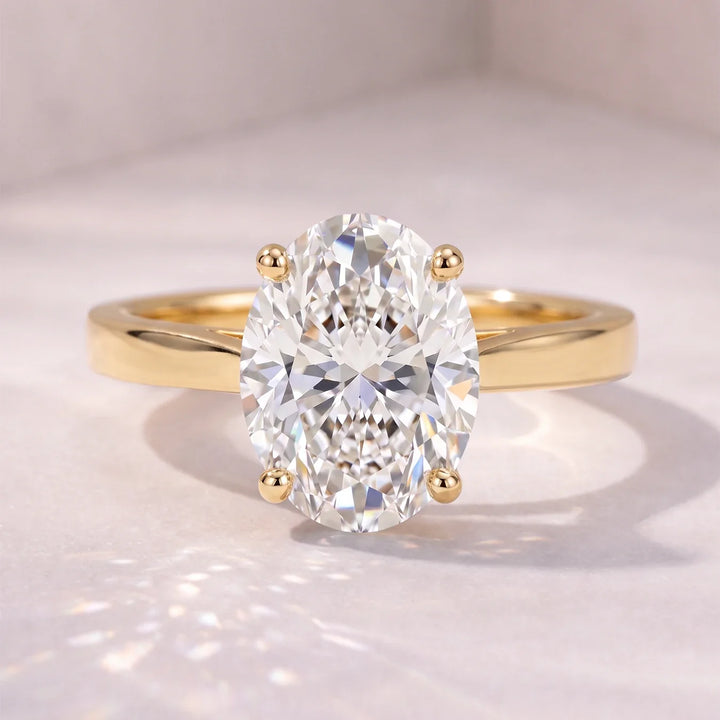
We recommend you match the Eden Engagement Ring with the Ivy Wedding Band.
Step into the world of Lily Arkwright, we offer virtual WhatsApp appointments. Alternatively, visit our London or Manchester showrooms to find your perfect Diamond Ring.
Book your appointment, Click Here.
Simply choose Klarna during checkout and select your preferred payment option, Pay in 30 days, Pay in 3 or monthly instalments between 0 - 36 months, starting from 0%.
For more details, Click Here.
Our consultants have a wealth of knowledge and passion to help you choose the perfect ring.
See our FAQ's or Get In Touch






A natural diamond brings the earth’s geological history into a piece of jewellery. Formed under intense heat and pressure deep beneath the surface, most natural diamonds are more than a billion years old. For someone drawn to their natural origin, that history can become part of the meaning behind an engagement ring or a piece chosen to mark an important occasion.
Your interpretation can be simple or more detailed. A solitaire can place the emphasis on an individual diamond, while a halo or trilogy brings the surrounding stones into the design. Begin with the combination of shape, light and setting you would enjoy wearing.
Natural diamonds and laboratory-grown diamonds are both diamonds. They have essentially the same chemical composition, crystal structure and physical and optical properties. The distinction is their origin: natural diamonds formed within the earth, while lab-grown diamonds are created under controlled conditions. Moissanite is a separate gemstone, not another type of diamond.
Choosing a natural diamond establishes the origin you prefer, but it is only the beginning of the decision. Consider the individual stone’s appearance, proportions and documented characteristics rather than treating natural origin as a description of its quality.
This also gives you a clearer basis for comparing jewellery. Identify the gemstone and its origin first, then consider how the particular stone works within the finished design.
Natural diamonds do not all have the same colour appearance. Within the standard D-to-Z colour scale, D represents colourless, with increasing amounts of yellow or brown towards Z. Some differences between neighbouring grades are subtle, so read the colour assessment alongside photographs and videos of the individual diamond.
Clarity describes the presence of internal features, called inclusions, and surface features, called blemishes. Grading considers these characteristics under 10× magnification, including their size, position and nature. A feature recorded in a clarity assessment is not necessarily visible to the unaided eye.
The aim is to understand what the grades mean for the stone you are considering. Look at its overall appearance rather than choosing from a colour or clarity label alone. Consider which characteristics matter most to you and how they fit within your preferred design and budget.
Shape describes a diamond’s outline, while cut also concerns the arrangement and proportions of its facets and how they interact with light. Two diamonds with the same shape can therefore have different appearances. The outline is a starting point, not a complete description of the stone.
Consider a round centre for a symmetrical design, an oval for a more elongated outline, or a pear for its combination of a rounded end and a tapering point. More angular shapes offer another direction, particularly when you prefer a setting with defined lines.
Compare the individual diamonds in motion as well as in still photographs. Look at the balance of light across the stone rather than focusing on a single bright reflection. The most suitable choice is the one whose appearance you continue to enjoy as the viewing angle changes.
Carat measures a diamond’s weight, not its dimensions. Diamonds of the same carat weight can differ in their measurements and proportions, so the carat figure alone does not establish how large a stone will look within a setting.
For an engagement ring, consider the centre diamond in relation to the band width, setting height and your finger. For earrings or a pendant, think about the scale you would enjoy wearing.
Where a design contains several diamonds, distinguish between the centre-stone weight and the total carat weight. The latter describes the combined weight of the diamonds, rather than the weight of one central stone.
A larger carat figure need not be the starting point for every decision. Establish the proportions and overall presence you want, then consider the stones that suit that design.
A solitaire gives the centre diamond the clearest visual role. A halo creates a surrounding frame, while a trilogy makes the relationship between the centre and side stones a more prominent part of the design.
Consider platinum or white gold for a cool-toned palette, yellow gold for warmth, or rose gold for a softer contrast. Choose the combination that works with your taste and the jewellery you expect to wear beside it.
The smaller details deserve attention, too. Think about the width of the band, the appearance of the claws and the balance between the centre diamond and any accompanying stones. Check the specification of those additional stones separately, including their material, origin and weight.
For an engagement ring, consider how the setting sits alongside a wedding band. Look at the complete pairing rather than assessing each ring in isolation.
Diamond is highly resistant to scratching, but it is not indestructible. A hard impact can cause chipping or fracture, making the setting and the way a piece is worn important parts of its care.
Think about how the design fits your routine. Consider the height of an engagement ring, whether its profile feels comfortable and how well its proportions suit everyday wear.
Cleaning should take account of the complete piece, including its metal, other gemstones and any treatments. Follow the care instructions provided, and have the setting checked before professional ultrasonic or steam cleaning, as these methods can loosen stones in their settings.
Natural origin may be what first draws you to a diamond, but the finished piece should reflect more than that single preference. Its shape, proportions and setting all contribute to how it feels to wear.
Within a Lily Arkwright design, a natural diamond can mark an engagement, an anniversary or a personal milestone. Its geological history belongs to the stone; the meaning of the jewellery comes from the occasion, the person and the life in which it will be worn.
We’re proud to be recognised consistently by the UK jewellery industry’s leading awards programmes. In 2026, Lily Arkwright has been shortlisted for Branded Boutique of the Year at the Professional Jeweller Awards and Bridal Jewellery Retailer of the Year at the UK Jewellery Awards, reflecting our continued commitment to exceptional customer service, product innovation, and ethical craftsmanship.
These latest nominations build on previous industry recognition, including being shortlisted for Bridal Jewellery Retailer of the Year at the 2025 UK Jewellery Awards and Independent Retailer of the Year at the Professional Jeweller Awards 2025. We were also finalists for Retail Team of the Year at both the Retail Jeweller Awards and Professional Jeweller Awards in 2024, recognising the passion, expertise, and dedication of our team.
We’re honoured to be recognised for helping thousands of couples find the perfect engagement rings and wedding rings, with a strong focus on choice, transparency, and personalisation. As an award-winning jeweller, we remain committed to delivering exceptional service, exceptional craftsmanship, and responsibly sourced lab-grown diamonds, moissanite, and natural diamonds, ensuring every customer can find a ring that perfectly reflects their love story.
At Lily Arkwright, Community Matters Lily Arkwright’s roots lie in leafy Didsbury, Manchester. While we have grown into one of the UK’s leading fi...
Read moreThis year marks Lily Arkwright's 5th year of supporting Unicef during Black Friday building upon our successful 2019 Unicef Halloween Ball partne...
Read more
