








Social Champions
At Lily Arkwright, Community Matters Lily Arkwright’s roots lie in leafy Didsbury, Manchester. While we have grown into one of the UK’s leading fin...
Read moreDiscover 3 carat engagement rings with a prominent centre stone and a choice of lab grown diamonds, natural diamonds, coloured lab diamonds, gemstones and moissanite. Explore designs in platinum, 18k yellow gold, white gold and rose gold, from simple solitaires to detailed halo, trilogy and pavé settings.
When choosing a 3ct engagement ring, consider how the centre stone and setting work together. A solitaire draws attention to the stone’s shape, while a trilogy introduces complementary side stones. Compare setting height, band width and wedding-band fit to find a design that suits your preferences and everyday wear.
Carat weight alone does not determine how large a ring looks. Stone type, cut and proportions influence its appearance, so compare millimetre measurements and the selected centre-stone option on each product page.
Carat weights refer to the centre stone unless otherwise stated. Halo and shoulder stones contribute separately to total carat weight. For moissanite, diamond-equivalent carat weights describe comparable size rather than actual stone weight.


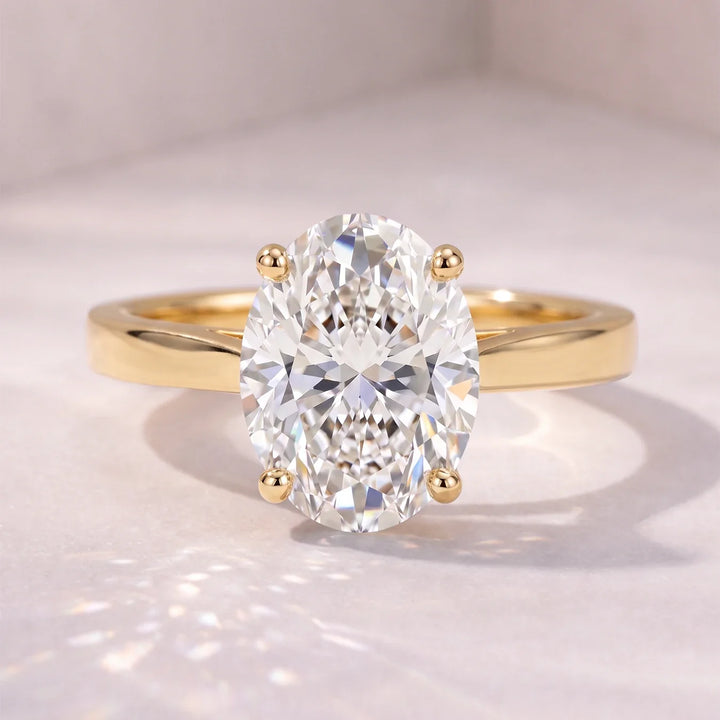
A three-carat centre stone can create a striking engagement ring, with room for its outline and faceting to define the design. Carat measures weight, so compare the stone's millimetre dimensions before deciding how much presence you want on the hand.
A simple solitaire puts the emphasis on the diamond. A hidden halo adds detail below the centre, while a visible halo or diamond shoulders extend the sparkle around it. Compare the band width, setting height and side view to understand the proportions of the complete ring.
Three-carat diamonds can differ in length, width and depth. An elongated outline and a square or round outline use that weight differently. More carat weight does not guarantee more sparkle: assess the cut and the appearance of the individual diamond in photographs, video or in person.
Use the displayed price for your chosen product and configuration. A three-carat ring's cost depends on the centre-stone material and specifications, precious metal, construction and accent stones. Confirm which parts of the ring are included in any quotation.
Lab grown and natural diamonds have different origins and market prices. Compare the stones you are actually considering, with similar specifications and settings, rather than treating an old market range or a fixed saving percentage as a quotation. Your budget can then guide the balance of size, quality and design.
Check the issuing laboratory, report number, report date and document type for your selected diamond. IGI lab-grown reports use individual colour and clarity grades. Since 1 October 2025, GIA's colourless to near-colourless lab-grown service uses a Premium or Standard quality assessment. Earlier GIA documents and coloured-diamond reports have different formats. Ask to see the actual document before comparing stones.
At this size, it is especially useful to assess inclusion position, contrast and type in the chosen diamond. VS1 or VS2 is not a guarantee of an eye-clean appearance, and some SI stones may look clean under normal viewing. Ask for an individual assessment and view the diamond in more than one lighting condition.
A lab grown diamond is a diamond produced in a laboratory. That identity alone does not establish its energy source, environmental footprint or complete journey to the setting. If these details matter to you, discuss the available supplier documentation for the specific stone.
Also consider your daily activities, comfort and the way the ring fits beside a wedding band. Protect the setting from knocks and heavy manual work, and arrange periodic checks as part of caring for the finished piece.
Check the current product price after selecting the centre stone, metal and setting. Different specifications can produce very different totals; our specialists can help compare designs within your budget.
Compare dimensions, cut and setting as well as weight. Visible size and light performance vary between individual diamonds.
Report formats depend on the laboratory, stone type and issue date. Check the actual document for your selected diamond rather than assuming that every report uses the same grading terminology.
We’re proud to be recognised consistently by the UK jewellery industry’s leading awards programmes. In 2026, Lily Arkwright has been shortlisted for Branded Boutique of the Year at the Professional Jeweller Awards and Bridal Jewellery Retailer of the Year at the UK Jewellery Awards, reflecting our continued commitment to exceptional customer service, product innovation, and ethical craftsmanship.
These latest nominations build on previous industry recognition, including being shortlisted for Bridal Jewellery Retailer of the Year at the 2025 UK Jewellery Awards and Independent Retailer of the Year at the Professional Jeweller Awards 2025. We were also finalists for Retail Team of the Year at both the Retail Jeweller Awards and Professional Jeweller Awards in 2024, recognising the passion, expertise, and dedication of our team.
We’re honoured to be recognised for helping thousands of couples find the perfect engagement rings and wedding rings, with a strong focus on choice, transparency, and personalisation. As an award-winning jeweller, we remain committed to delivering exceptional service, exceptional craftsmanship, and responsibly sourced lab-grown diamonds, moissanite, and natural diamonds, ensuring every customer can find a ring that perfectly reflects their love story.
At Lily Arkwright, Community Matters Lily Arkwright’s roots lie in leafy Didsbury, Manchester. While we have grown into one of the UK’s leading fin...
Read moreThis year marks Lily Arkwright's 5th year of supporting Unicef during Black Friday building upon our successful 2019 Unicef Halloween Ball partner...
Read more
