











Shipping
Lily Arkwright is proud to offer free worldwide delivery and returns.
We aim to dispatch most orders within 7–28 days. Selected bespoke designs may take 5–6 weeks.
Estimated delivery times after dispatch:
- UK: Next working day
- Europe: 2–5 working days
- US & Canada: 3–5 working days
- Rest of the world: Typically 3–5 working days
All parcels are dispatched through our nominated couriers, fully insured and requiring a signature upon delivery.
Returns
Enjoy a 50-day money-back guarantee with complimentary worldwide return postage on eligible purchases, starting from the date of delivery.
To arrange a return or exchange, please email hello@lilyarkwright.com to request a Returns Number (RN) and return instructions. Please retain proof of postage.
Returned jewellery must be unworn, in its original condition and accompanied by its original packaging and relevant certificates.
Certain engraved, personalised or genuinely bespoke pieces may be excluded from change-of-mind returns, without affecting statutory rights.
For orders exceeding £15,000, the change-of-mind returns period is 14 days rather than 50 days, without affecting your statutory rights.
Please see our Delivery & Returns Policy for full details.
A little bit more sparkle perhaps?
You've found your near perfect Lily Arkwright ring, but there's something missing.
Rather than creating a bespoke ring design, simply select any of our popular ring upgrade packages from pointed prongs to a hidden diamond halo, we've got you covered.
View all upgrades here.
Matching Wedding Band
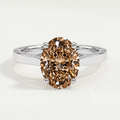
We recommend you match the Everdeen Engagement Ring with the Ember 2.20mm Wedding Band.
LONDON - MANCHESTER
Book an Appointment
Step into the world of Lily Arkwright, we offer virtual WhatsApp appointments. Alternatively, visit our London or Manchester showrooms to find your perfect Diamond Ring.
Book your appointment, Click Here.
Payment Options
Klarna 0% Interest Available
Simply choose Klarna during checkout and select your preferred payment option, Pay in 30 days, Pay in 3 or monthly instalments between 0 - 36 months, starting from 0%.
For more details, Click Here.
Speak To An Expert
We're Here To Help
Our consultants have a wealth of knowledge and passion to help you choose the perfect ring.
See our FAQ's or Get In Touch
Certified






Recently viewed
ABOUT YOUR CENTRE DIAMOND
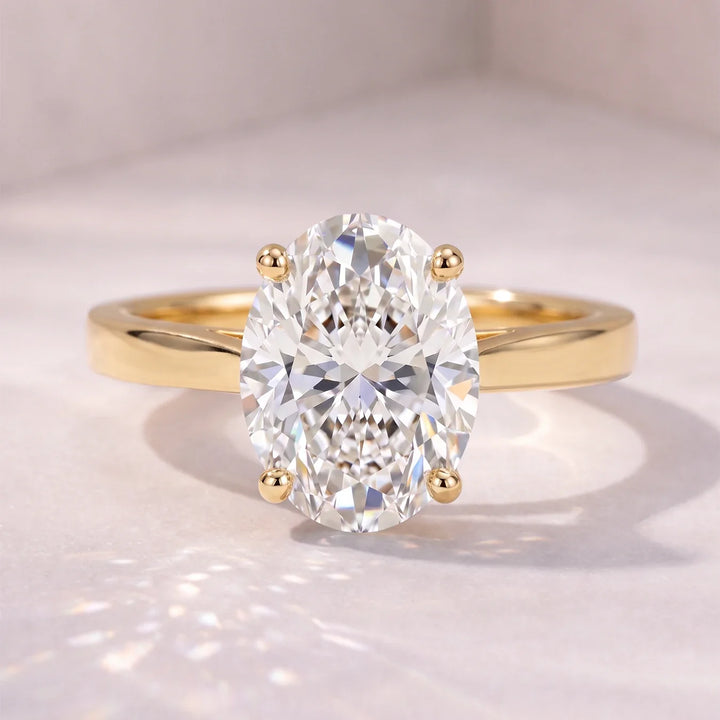
Yellow lab-grown diamonds
A yellow lab-grown diamond makes colour an intentional part of an engagement ring. Rather than seeking a largely colourless appearance, this choice places a yellow centre stone at the heart of the design. It offers a different direction for someone who loves diamond but wants the ring’s character to begin with a warm colour.
The finished look need not be elaborate. A simple setting can give a yellow diamond a clear, uninterrupted presence, while a more detailed design can introduce contrast through its metal and surrounding stones. The question is not whether yellow belongs in a traditional or modern ring, but how you want to wear it.
Yellow diamonds and the white diamond colour scale
A yellow diamond should not be judged solely by the criteria used to choose a colourless diamond. Within the conventional D-to-Z range, colour grades describe increasing amounts of yellow or brown tint. Fancy-colour assessment addresses a different appearance, in which the colour itself is a defining feature.
Not every diamond with a slight yellow tint qualifies as fancy yellow. The distinction depends on the stone’s assessed colour, not simply on a retailer’s descriptive wording. A formal report can help separate a faintly tinted diamond from one evaluated within a fancy-colour category.
This is why comparing a yellow lab-grown diamond with a D-colour white diamond is not a straightforward comparison of higher and lower quality. They are different colour choices. For the yellow stone, your preference concerns the presence and character of colour rather than its absence.
Where yellow colour comes from
Nitrogen within the diamond’s crystal structure is a common cause of yellow colour in laboratory-grown diamonds. Small changes at an atomic scale can influence which parts of light the stone absorbs, producing the colour we see.
Growth conditions and, in some cases, subsequent processing can contribute to the finished appearance. The production and treatment history of an individual stone should be confirmed from its documentation and supplier information. The word “yellow” alone does not establish every stage of that history.
The essential identity remains diamond. Yellow colour does not make the centre stone a sapphire, citrine or another yellow gemstone, even when those materials appear in similar ring styles. Comparing gemstone identity as well as appearance helps keep your choices clear.
Choosing the character of the yellow
Begin with your own response to the colour. You may prefer a lighter-looking yellow or a stronger, more prominent shade. Consider whether the centre stone should provide a gentle accent or become the feature you notice first.
It is also useful to separate preference from scale. A stronger colour does not automatically suit your hand, wardrobe or chosen setting better than a lighter one. View the diamond as part of a ring, not only as an isolated colour sample.
How cutting can influence colour
The way a diamond is fashioned can influence its face-up colour appearance. Facet arrangement and proportions affect the paths light takes through the stone, and some cutting styles can help concentrate visible colour.
Radiant-style cuts are one example associated with enhancing the appearance of yellow in diamonds. That does not mean every radiant will look stronger in colour than every oval, cushion or round. The individual stone, rather than the shape name alone, remains the basis for comparison.
When considering a yellow centre, look at the balance between colour and the pattern of reflections. Decide whether you enjoy the stone’s appearance across its outline, including areas that become brighter or darker as it moves.
A video or viewing can support this assessment. For a ring you intend to wear regularly, the everyday impression matters more than finding one angle that looks particularly striking.
Yellow gold, white metal or a contrasting palette
Yellow gold offers a coordinated styling approach, bringing the warmth of the metal into the same composition as the centre stone. It may suit someone who wants the ring to read as an integrated colour palette rather than a pronounced contrast.
Platinum or white gold provides another direction, placing the yellow within a cooler frame. Rose gold introduces a different combination of warm colours. None of these pairings is compulsory: the preferred effect depends on the actual stone and the rest of the design.
A metal choice does not change the diamond’s laboratory colour grade. Consider the diamond’s own colour and the appearance of the completed ring as related but separate matters.
Include the wedding band in that decision. A coordinated band can continue the palette, while a contrasting one can make the engagement ring a more distinct element within a pair.
Balancing the centre stone and surrounding detail
In a solitaire, the yellow diamond can be the main source of visual interest. In a halo or trilogy, additional stones introduce another relationship to consider: how much of the overall composition should belong to the yellow centre?
White side stones may suit a design in which you want a clear distinction between the central colour and its surroundings. A more restrained setting may appeal when you prefer the shape and yellow hue to do most of the work.
Consider dimensions, band width and setting height together. A larger centre stone is not automatically the most balanced choice, particularly when a ring includes substantial side details. Start with the impression you want the complete ring to make.