


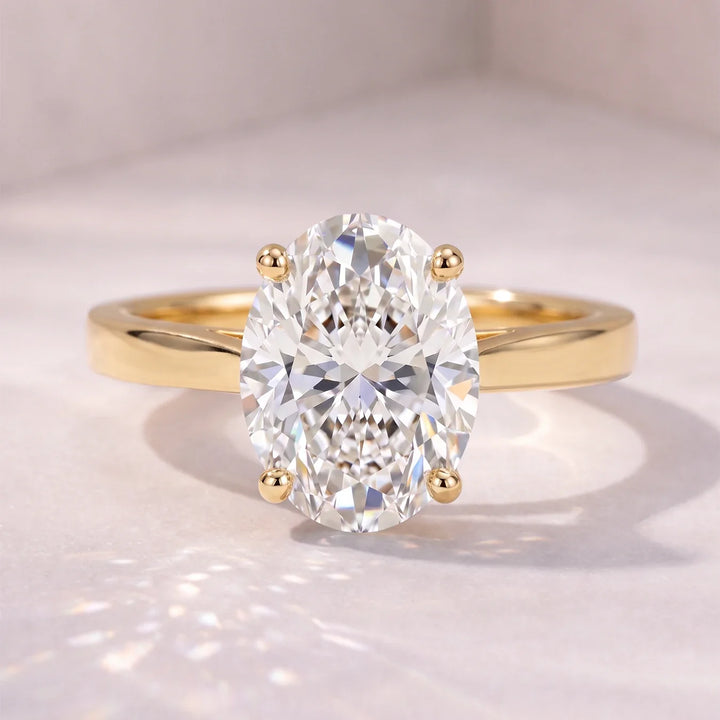







Charles & Colvard Stone Size Comparison Chart
Updated 10 November 2026
Start with the stone’s measurements in millimetres. They tell you how wide or long it is, which is more useful for picturing it on your hand than a carat label alone. These charts describe the gemstone’s size, rather than the ring size you need for your finger.
The Charles & Colvard panels below are a legacy reference for dimensions and approximate weights. Check the specification and current availability of the particular stone you’re considering before ordering.
To see how different shapes look in a finished setting, explore our moissanite engagement rings and check the measurements for the stone size you select.
Understanding the chart labels
- Millimetres (mm) describe dimensions. For a round stone, compare the diameter; for an oval or another elongated shape, read the length and width together.
- Carats measure weight. One carat equals 0.2 grams. The row labelled MOI gives the chart’s approximate average moissanite carat weight.
- Diamond-equivalent weight (DEW) is an approximate comparison with a similarly sized diamond. It is separate from the moissanite’s own weight.
How to compare two sizes
- Find the shape and cutting style you’re considering.
- Compare the millimetre measurements of two nearby sizes, checking both dimensions where they are given.
- Match those measurements to the stone offered for your chosen setting. Use its actual specification to make your final choice.
The drawings are not life-size on screen. Scroll sideways within each panel to see all the columns, and zoom in if needed. The weights are the supplier’s approximate reference figures, so they should not be treated as an exact conversion for every stone.
Round brilliant and round hearts & arrows

Cushion, elongated oval, radiant, princess and Asscher

Marquise, heart, oval, square brilliant, pear, emerald and trillion

Rose cuts

Old European, elongated cushion and side-stone shapes

Larger stones in the Exotic Gems chart

If you’re between sizes
Look at the whole ring as well as the centre stone. A halo, side stones and the width of the band all contribute to its appearance. If you can, compare similar settings on your hand and look at them from an ordinary viewing distance as well as close up.