


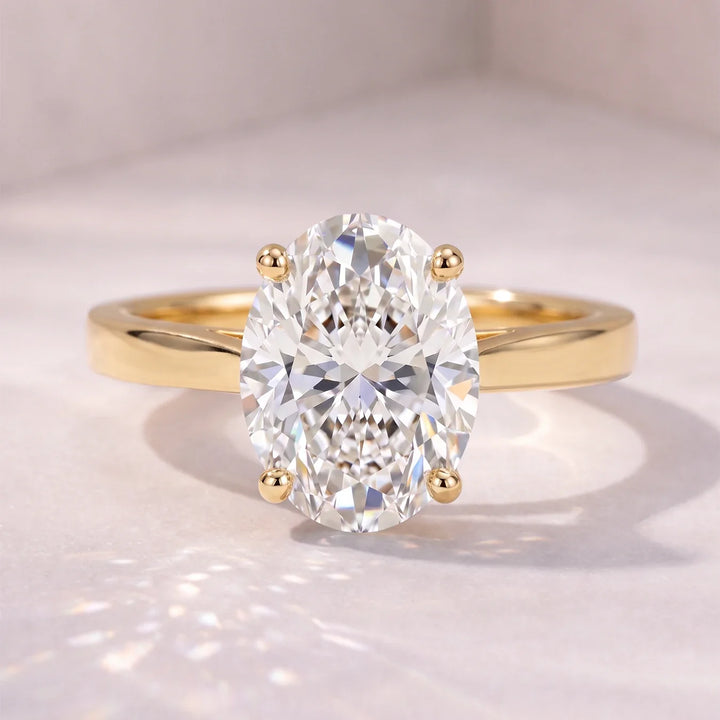







How to Choose the Carat Weight of Your Engagement Ring
Updated 29 October 2026
There is no single best carat weight for an engagement ring. Start with a budget you are comfortable with and the look you enjoy on your hand. Then compare the diamond’s measurements, cut and setting. Carat tells you how much a diamond weighs; it does not, by itself, tell you how large or bright it will look.
What does carat mean?
One carat, written as 1.00 ct, equals 0.2 grams. A carat can also be divided into 100 points, so a 50-point diamond weighs 0.50 ct. These are measurements of weight, not quality grades.
For the size you will see, look at the measurements in millimetres. Compare diameter for a round diamond and length and width for an oval or another elongated shape. Depth matters too: some of a diamond’s weight sits below the part you see from above.
What does a one-carat diamond look like?
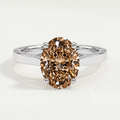
A 1 carat diamond engagement ring can be a useful starting point when you are trying different sizes. It is not a standard outline, though. A round, oval and cushion diamond can each weigh one carat while looking quite different on the hand.
Check the individual stone’s measurements rather than treating a carat-to-millimetre chart as an exact conversion. The band’s width and the setting around the diamond also change the overall impression. A close-up photograph is useful for detail, but it is not life-size on every screen.

How should you compare prices?
Choose a comfortable budget for the complete ring, including the diamond and setting. A comparison needs to account for the Four C's: cut, clarity, colour, as well as carat weight, along with whether the diamond is natural or laboratory-grown.
Natural and lab-grown diamonds are both diamonds, with different origins and markets. Compare current quotes for equivalent specifications; a saving on one pair of rings is not a fixed percentage across every weight or design.
For a setting example, Lily Arkwright's Eden Round Natural Diamond 18k White Gold Vine Solitaire combines a round centre with vine-style shoulders. Compare the available centre stones within the same design, and ask which specifications are included in each quote. Do not assume every weight comes with identical colour, clarity or cut.
A slightly different weight may also be worth considering if it gives you a diamond you prefer within your budget. There is no need to reach a round number simply because it sounds better.
One carat or two carats?
A 2 carat diamond engagement ring has twice the centre weight of a one-carat ring only when both descriptions refer to the centre diamond. It will not have twice the diameter. The visible difference depends on shape and proportions, so compare the actual measurements and, where possible, view the rings together.
Keep the shape and setting similar for a useful comparison. Then try another shape if you want to explore a different outline. An elongated diamond changes the balance of length and width; that does not make it a better choice for everyone.
Centre weight and total carat weight
Check whether a quoted weight refers to the main diamond or all the diamonds in the ring. For example, a 1.00 ct centre with 0.20 ct of smaller diamonds has a total diamond weight of 1.20 ct. It does not have a 1.20 ct centre. This is an illustrative example, not the specification of either ring pictured here.
This distinction matters with halos, trilogy rings and pavé bands. If a design mixes diamonds with other gemstones, ask for the materials and weights separately rather than assuming every stone contributes to a total diamond weight.

Look at the cut as well as the size
A diamond’s proportions and faceting affect how it handles light. A heavier stone is not automatically brighter. Look at the diamond as it moves, rather than choosing from one still photograph alone.
Ask what the report tells you about the particular shape. GIA’s standard cut grading system applies to round brilliant diamonds in the D-to-Z colour range; it should not be treated as a universal scale for every shape.
Choose the ring you want to wear
Try a few sizes in the style you like and look at your hand from an ordinary viewing distance. Notice the height of the setting, the band’s width and how the ring feels when you bend your fingers. If you plan to wear a wedding band alongside it, try the two together.
There is no required carat weight for a particular finger size. Before deciding, ask for the centre weight, millimetre measurements, any accent-stone weight and the complete price. Those details make the choice clearer than a headline carat figure alone.
Your preferred diamond carat weight should sit comfortably alongside the shape, setting and budget you have chosen. Pick the combination you enjoy wearing.
Diamond information: GIA carat weight guidance and GIA cut guidance.